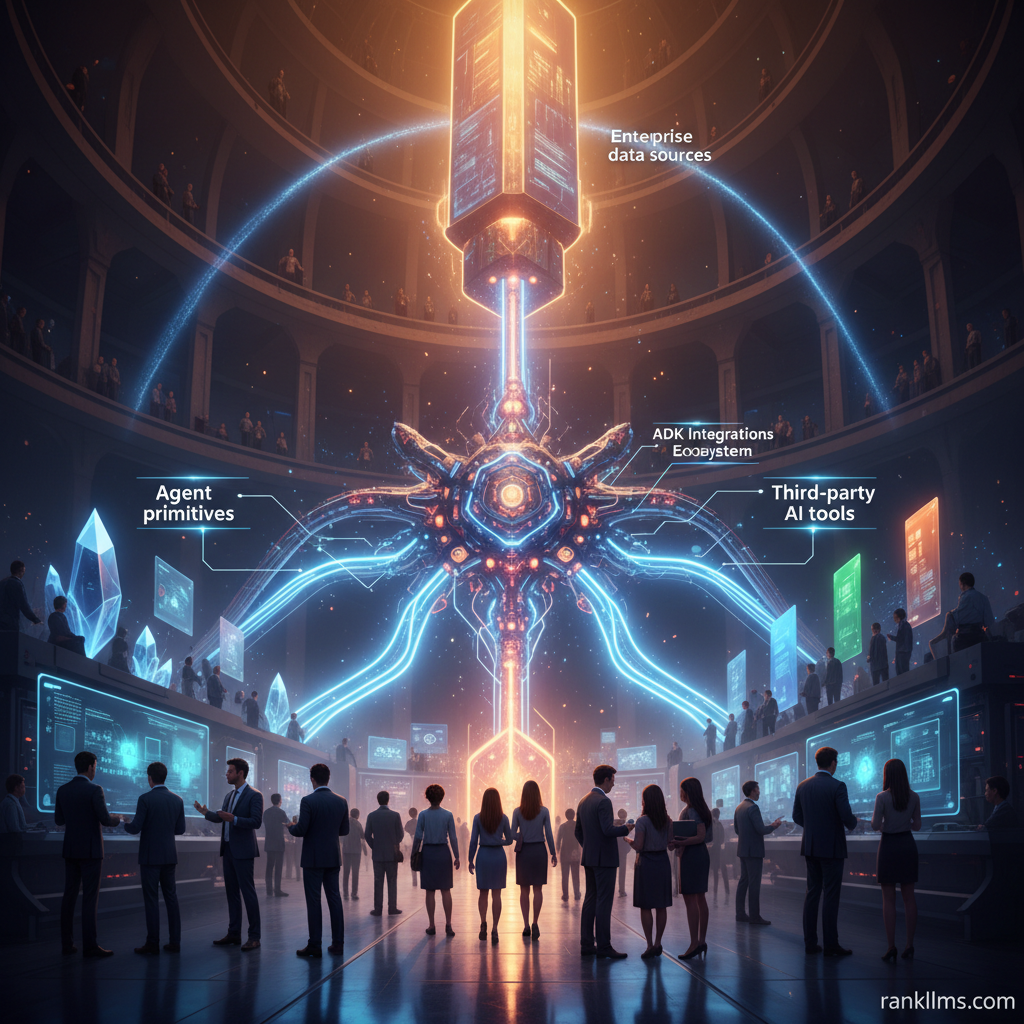
The ADK Integrations Ecosystem is an integration fabric that lets teams compose agentic AI workflows by connecting built-in agent primitives to third-party AI tools and enterprise data sources. This post explains what it is, why it matters for AI Agent Development and Workflow Automation, how to design a safe, measurable MVP, and where the technology is headed.
Intro
Quick answer (featured-snippet friendly)
- ADK Integrations Ecosystem lets teams compose agentic AI workflows by connecting built-in agent primitives to third-party AI tools and data sources for automated, context-aware task execution.
- Benefits: faster decision loops, reusable workflow templates, strong human-in-the-loop controls, and measurable ROI for knowledge-work teams.
ADK puts a standard integration layer between autonomous agents and the outside world so agents can call specialized services (speech, vision, retrieval, code) and enterprise APIs in a controlled, observable way. Think of ADK as a power strip for agent capabilities: instead of wiring each device directly to a single outlet, agents plug into a managed hub that provides identity, governance, and consistent interfaces.
Why this matters
- One-sentence summary: For teams building autonomous workflows, the ADK Integrations Ecosystem accelerates AI Agent Development and Workflow Automation by standardizing how agents call Third-party AI tools and interact with existing systems.
- Who should read this: product managers, engineering leads, and automation architects exploring Agentic AI ecosystem design and governance.
ADK reduces integration friction, improves auditability, and enables template markets for repeatable agent behaviors—important when teams must balance automation velocity with enterprise controls.
Background
What is the ADK Integrations Ecosystem?
The ADK Integrations Ecosystem is a framework and set of connectors that let AI agents integrate with external APIs, data stores, and Third-party AI tools. It provides:
- Connectors: adapters that normalize auth, data formats, and rate limits for systems like Slack, Google Workspace, Jira, and Git providers.
- Runtimes: secure sandboxes where agent actions execute with tenant isolation.
- Orchestration layer: a planner/executor model that sequences agent decisions and enforces guardrails.
- Developer SDKs: primitives for composing agent behavior, calling external tools, and handling retries and errors.
This approach moves beyond one-off webhooks to a unified developer experience that accelerates AI Agent Development while preserving governance.
Key terminology and concepts
- ADK Integrations Ecosystem — the integration fabric for agentic systems.
- AI Agent Development — building autonomous agents that can plan, act, and delegate across services.
- Third-party AI tools — specialized models or services (speech, vision, retrieval, code) that agents call to augment capabilities.
- Workflow Automation — end-to-end composition of tasks, approvals, and data flows that agents coordinate.
How ADK differs from traditional integrations
- Native agent primitives vs. point-to-point webhooks: ADK exposes high-level actions (e.g., propose action, request approval) rather than raw HTTP callbacks.
- Agent observability & explainability: built-in logging, rationales, and role-based explanations help teams audit agent behavior.
- Templates & marketplace potential: standardized connectors make reusable templates viable, accelerating adoption across teams.
For a practical primer on ADK architecture and connectors, see the official developer post (Google Developers) for implementation details and examples: https://developers.googleblog.com/supercharge-your-ai-agents-adk-integrations-ecosystem/.
Trend
Macro trends driving adoption
Several converging trends are pushing teams toward ADK-style integration fabric:
- Rapid improvement in LLMs and multimodal models increasing agent capabilities (better context, higher fidelity actions).
- Enterprise demand for automation that preserves human oversight and governance—buyers ask for explainability and audit trails.
- Proliferation of specialized Third-party AI tools, creating a composable Agentic AI ecosystem where best-of-breed models are called as needed.
Analysts highlight the economic potential: firms like McKinsey and PwC estimate large gains from automation when coordination overhead is reduced; buyers increasingly list privacy, auditability, and integration depth as critical purchase criteria (see McKinsey and PwC research for background: https://www.mckinsey.com, https://www.pwc.com).
Market signals and user research highlights
- Enterprise evaluations focus on connector depth (how well the tool integrates with core systems), governance controls, and demonstrable ROI.
- Early adopters succeed by starting small—MVPs like meeting assistants or contextual task suggestions deliver measurable user value quickly.
Snapshot: where teams start
Most successful early adopters pick a narrowly scoped workflow—e.g., a meeting assistant that captures audio, transcribes, and suggests action items—then iterate to expand templates into a marketplace once usage and ROI are proven. This staged approach minimizes risk and clarifies integration priorities.
Insight
What makes autonomous workflows productive (practical takeaways)
- Keep humans in the loop: role-based explainability and lightweight approval gates increase trust and reduce false positives.
- Integrate deeply: surface context from Slack, Google Workspace, Jira, and Git providers to make agent actions accurate and context-aware.
- Measure impact: track time saved, task completion uplift, and adoption rates; tie them to product KPIs and procurement requests.
Example: a meeting assistant that integrates calendar metadata + audio transcription + project tracker can propose action items with owner assignments. When presented with a short rationale (\”Assigned to Alex because they were listed as owner in the doc and discussed task at 12:07\”), humans approve faster and adoption grows.
Architecture & design patterns (short, actionable checklist)
1. Intent and scope: define the agent’s domain, success criteria, and failure modes.
2. Connectors layer: implement adapters for identity, data access, and Third-party AI tools with least-privilege auth.
3. Orchestration: separate planner (policy, reasoning) from executor (side-effects, API calls).
4. Human-in-the-loop gates: approvals, explanations, and rollback hooks.
5. Audit & governance: immutable logs, tenant isolation, configurable retention.
Implementation: step-by-step for a focused MVP
- Step 1: Identify a high-value workflow (e.g., meeting assistant that creates action items).
- Step 2: Map needed integrations (calendar, audio transcription, project management tool).
- Step 3: Use ADK connectors to normalize inputs and call Third-party AI tools (speech-to-text, classification).
- Step 4: Present suggestions with short, role-specific rationales; capture approval.
- Step 5: Measure ROI and iterate; expand to additional templates if adoption is strong.
Risk management and governance
- Data minimization: process only required fields; offer tenant-isolated or on-device options.
- Explainability: short, human-readable rationales tailored to managers, engineers, and designers.
- Compliance: align retention and audit logs with regulatory requirements (note EU AI regulatory focus). Comprehensive governance reduces legal exposure and accelerates enterprise deployment.
Forecast
Near-term (6–18 months)
Expect a surge in connector libraries and template marketplaces for common knowledge-work tasks. Vendors will prioritize governance features—role-based explainability, stronger audit logs, and configurable retention—because procurement teams demand them.
Mid-term (2–3 years)
The Agentic AI ecosystem will coalesce around standardized connector specs and third-party tool certification programs. Workflow Automation will be a measurable line-item in procurement, with clear ROI metrics required for budget approval.
Long-term (3–5 years)
Autonomous workflows will become tightly integrated with business process automation at scale: agents will orchestrate cross-functional processes with human checkpoints, while new \”trust layers\” (verification, attestation, insurance services) will emerge to validate agent actions.
Practical roadmap for teams (featured-snippet friendly checklist)
- Start with a focused MVP (meeting assistant or contextual task suggestions).
- Instrument KPIs from day one: time saved, task completion uplift, adoption.
- Prioritize integrations with high-context tools (Slack, Google Workspace, Jira, Git).
- Bake in governance: explainability, audit logs, and privacy controls.
These steps help teams capture immediate value and position themselves to scale templates and marketplaces once adoption is proven.
CTA
Immediate next steps
- Read the official primer for technical examples and connector patterns: https://developers.googleblog.com/supercharge-your-ai-agents-adk-integrations-ecosystem/
- Try a scoped proof-of-concept: pick one workflow, wire up 2–3 connectors, and measure lift after two sprints.
Resources and offers
- Starter checklist for ADK Integrations Ecosystem adoption (downloadable).
- Template ideas marketplace: meeting assistant, contextual task suggestions, weekly progress snapshot.
- Invite: join a demo/webinar for engineering + product teams to see an ADK integration walkthrough.
FAQ (short answers optimized for snippets)
Q: What is the ADK Integrations Ecosystem in one line?
A: A framework that helps AI agents call and coordinate Third-party AI tools and enterprise systems to automate context-aware workflows.
Q: Why prioritize integrations over building models in-house?
A: Connectors unlock immediate business value by letting agents access real data and best-in-class specialized models, accelerating AI Agent Development and ROI.
Q: How do teams protect sensitive data when using agentic workflows?
A: Use tenant-isolated processing, on-device options, configurable retention, and audit logs; limit scopes per connector.
Further reading: analyst perspectives on enterprise automation (McKinsey, PwC) and the ADK developer primer offer practical guidance for teams planning their first ADK-powered MVP (see https://www.mckinsey.com and https://www.pwc.com).