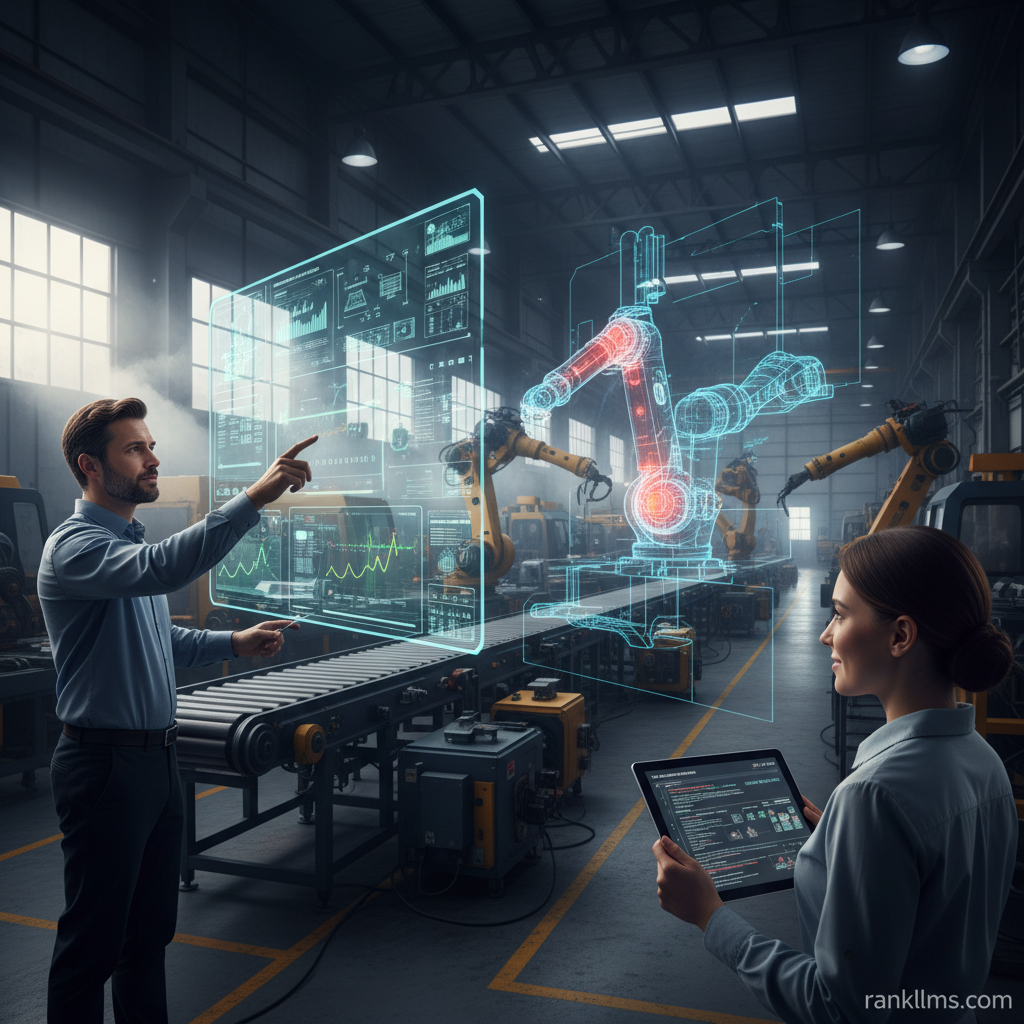
This post explains how Claude AI for industrial IoT powers Predictive Maintenance 2.0 by combining contextual reasoning with real-time sensor analysis AI. We cover background, current trends, an implementation-ready insight section, and a near-term forecast for manufacturing and heavy industry.
Intro
At a glance (featured snippet candidate)
- Short definition: Predictive Maintenance 2.0 uses advanced models like Claude AI for industrial IoT to turn real-time sensor analysis AI into actionable maintenance decisions that minimize downtime and extend asset life.
- 3 quick benefits:
- Reduced unplanned downtime via earlier, higher-confidence fault detection.
- Smarter spare-parts planning from predictively-ranked part-failure windows.
- Faster root-cause discovery and explainable guidance using predictive maintenance AI.
- One-line value proposition: Use Claude for manufacturing to add contextual reasoning and industrial intelligence frameworks to your IoT stack.
Opening overview
This post explains how Claude AI for industrial IoT powers Predictive Maintenance 2.0 by combining contextual reasoning with real-time sensor analysis AI. We’ll look at what differentiates this new wave of predictive maintenance, why manufacturers are choosing Claude for manufacturing deployments, and provide a practical implementation blueprint plus forecasts for the next 1–5 years.
Background
What is Predictive Maintenance 2.0?
Predictive Maintenance 2.0 evolves classic predictive maintenance by moving from isolated anomaly detection to context-aware, multimodal reasoning across edge and cloud. Traditional systems often relied on threshold alerts or single-signal models (vibration, temperature). PM 2.0 integrates streaming sensor data, equipment telemetry, maintenance logs, and operator notes — then applies reasoning models to prioritize actions and explain predictions. It emphasizes orchestration between edge compute (for low-latency inference) and cloud services (for large-context training and fleet-wide learning).
In that stack, Claude AI for industrial IoT acts as the inference and reasoning layer: a model that synthesizes live sensor streams with maintenance histories and digital twins to produce prioritized, explainable maintenance actions. For manufacturers, that means moving from “sensor said there’s a spike” to “sensor spike + historic bearing wear + recent lubricant change = 72% probability of bearing failure in 48–72 hours; schedule replacement and order part X.” (See practical deployment examples in Claude’s engineering guidance Harnessing Claude’s Intelligence.)
Why Claude for manufacturing?
Claude’s strengths for industrial use include:
- Large-context reasoning: ingests long maintenance histories and fleet-wide patterns to spot subtle failure precursors.
- Multimodal understanding: combines streaming sensor data, images (e.g., thermal scans), and text (maintenance logs) for richer diagnoses.
- Faster anomaly explanation: generates human-readable root-cause summaries that technicians can act on.
- Integrations with industrial intelligence frameworks: designed to be pluggable into standard industrial APIs and CMMS systems.
These capabilities make Claude particularly suited for environments where explainability, safety validation, and operational context are as important as raw detection accuracy.
Core components of a modern solution
A production-ready Predictive Maintenance 2.0 architecture typically includes:
- IoT sensors & gateways (vibration, temperature, acoustic, thermal cameras)
- Edge compute for low-latency preprocessing and initial inference
- Secure connectivity (MQTT/OPC UA with encrypted links)
- Claude AI inference layer for contextual diagnosis and action prioritization
- Digital twin & asset registry for authoritative asset context
- MLOps, model governance, and feedback loops to capture technician corrections and retraining signals
For more on how reasoning models fit into industrial stacks, see industry guidance on predictive maintenance architectures from IBM and research on real-time analytics (e.g., IBM’s resource on predictive maintenance) IBM Predictive Maintenance.
Trend
Adoption landscape
Manufacturers in both discrete (automotive, electronics) and process industries (chemicals, energy) are accelerating adoption of predictive maintenance AI. Key qualitative trends:
- Rapid growth of edge/cloud hybrid deployments to balance latency and model complexity.
- OEMs increasingly shipping equipment with embedded analytics that expose hooks for third-party reasoning layers.
- Investment shifting from proof-of-concept to operational pilots that measure MTTR, MTBF, and actual downtime reduction.
A useful analogy: think of legacy predictive maintenance as a smoke alarm and Predictive Maintenance 2.0 as a cardiologist who reads vitals, past tests, and lifestyle to give a treatment plan — not only sounding an alarm but prescribing a prioritized intervention.
Real-time sensor analysis AI is the enabler
Real-time sensor analysis AI capabilities are the foundation for Claude AI for industrial IoT. These include:
- Streaming anomaly detection that flags deviations at sub-second intervals.
- Signal de-noising and feature extraction to turn raw accelerometer or acoustic waves into robust predictors.
- Sensor fusion to combine multiple modalities (vibration + temperature + oil analysis) for higher-confidence predictions.
When these capabilities feed a reasoning model like Claude, the output shifts from noisy alerts to actionable, explainable interventions that technicians trust.
Evolution of industrial intelligence frameworks
Industrial intelligence frameworks are evolving to standardize schemas, APIs, and governance around telemetry and diagnostic outputs. Standardization makes models like Claude pluggable into manufacturing stacks and simplifies cross-vendor interoperability. Expect tighter standards for metadata, traceability, and explainability — enabling federated learning across plants while preserving data sovereignty and regulatory compliance.
Insight
How Claude AI enhances predictive maintenance workflows
Concrete improvements Claude brings to day-to-day maintenance:
- Faster root-cause summarization: condenses sensor anomalies and incident history into a one-paragraph diagnosis.
- Prioritized work orders with confidence scores: ranks tasks by predicted impact and confidence, enabling smarter crew allocation.
- Natural-language maintenance log synthesis: converts technician notes into structured signals for continuous learning.
- Predictive part-failure windows: provides time windows (e.g., 48–72 hours) for parts likely to fail, aiding procurement and scheduling.
- Explainability for safety validation: supports audits with traceable reasoning chains showing why a recommendation was made.
Implementation blueprint (featured-snippet-ready numbered list)
1. Define KPIs and failure modes to track (MTTR, MTBF, downtime minutes).
2. Inventory sensors and data quality; label historical failures where possible.
3. Design data pipeline (edge ingestion → preprocess → Claude inference → action broker).
4. Integrate Claude for manufacturing as a reasoning layer (anomaly -> diagnosis -> prioritized action).
5. Run pilot on a single asset class; measure model precision, recall, and operational impact.
6. Scale with MLOps: continuous training, data drift monitoring, and feedback loops from technicians.
Common pitfalls and how to avoid them
Pitfalls:
- Low-quality sensor data that leads to false alarms.
- Ambiguous or inconsistent failure labels.
- Lack of technician feedback causing model drift.
- Ignoring latency and edge constraints for real-time needs.
Mitigations:
- Implement sensor health checks and routine calibration.
- Use hybrid edge-modeling to prefilter and accelerate inference at the gateway.
- Set up human-in-the-loop validation and structured feedback from technicians.
- Start with phased rollouts: pilot, validate, iterate, then scale.
For practical examples and integration patterns, the Claude engineering guide provides deployment scenarios and safety considerations (see Harnessing Claude’s Intelligence).
Forecast
Near-term (1–2 years)
Expect widespread pilots of Claude AI for industrial IoT across manufacturing plants, with closer CMMS integrations and smarter schedules that combine constraints (parts, crew, downtime windows). Vendors will ship pre-built connectors and domain-tuned prompts to accelerate pilot time-to-value. Predictive maintenance AI will increasingly factor into capital-allocation decisions.
Mid-term (3–5 years)
- Edge-first inference becomes common for safety-critical controls; cloud hosts fleet learning and cross-site insights.
- Industrial intelligence frameworks will be mature enough to support pluggable models, enabling federated learning across plants for rare-failure prediction.
- Autonomous maintenance loops — where detection, diagnosis, procurement, and scheduling are coordinated automatically — will emerge for select asset classes.
A future implication: as reasoning models gain regulatory acceptance and explainability guarantees, insurance and warranty models will evolve to reward proactive, AI-driven maintenance regimes.
Business impact scenarios
Model ROI qualitatively by combining:
- Reduced downtime (minutes or hours avoided per year),
- Improved part utilization (fewer emergency spares),
- Labor efficiency (better technician utilization).
Create conservative, base, and optimistic scenarios to capture uncertainty and rare-event benefits. Use pilot metrics (precision/recall, MTTR improvement) to extrapolate fleet-level savings.
Regulatory and operational considerations
- Validate models in safety-critical environments with rigorous test harnesses.
- Maintain explainability and audit logs to satisfy industrial regulators.
- Plan for data sovereignty: many global sites will require local inference and federated learning to keep raw telemetry on-premises.
CTA
Actionable next steps checklist
- Run a readiness audit of sensors, networks, and asset registries.
- Select pilot assets where failure modes are known and data exists.
- Prepare labeled failure datasets and technician feedback channels.
- Engage an integration partner experienced deploying Claude for manufacturing and industrial intelligence frameworks.
Suggested featured-snippet meta and opening sentence (copy-paste ready)
- Featured-snippet candidate (one sentence): Claude AI for industrial IoT enables Predictive Maintenance 2.0 by turning real-time sensor analysis AI into explainable, prioritized maintenance actions that cut downtime and extend asset life.
- Meta description (max ~155 chars): Use Claude AI for industrial IoT to power Predictive Maintenance 2.0 — real-time sensor analysis, faster diagnostics, and lower downtime.
Next engagement
Suggested CTAs for the blog footer:
- \”Download the Predictive Maintenance 2.0 checklist\”
- \”Request a Claude-for-manufacturing pilot consultation\”
- Further reading: https://claude.com/blog/harnessing-claudes-intelligence
Resources & further reading
- Harnessing Claude’s Intelligence — implementation context and product examples: https://claude.com/blog/harnessing-claudes-intelligence
- IBM on predictive maintenance architectures and benefits: https://www.ibm.com/topics/predictive-maintenance
Key takeaways
- Predictive Maintenance 2.0 combines Claude AI for industrial IoT with real-time sensor analysis AI to produce context-aware, explainable, and prioritized maintenance actions.
- Start with a focused pilot, ensure data quality, and use industrial intelligence frameworks to scale responsibly.
- Use phased deployment, human-in-the-loop checks, and MLOps to sustain model performance and regulatory compliance.