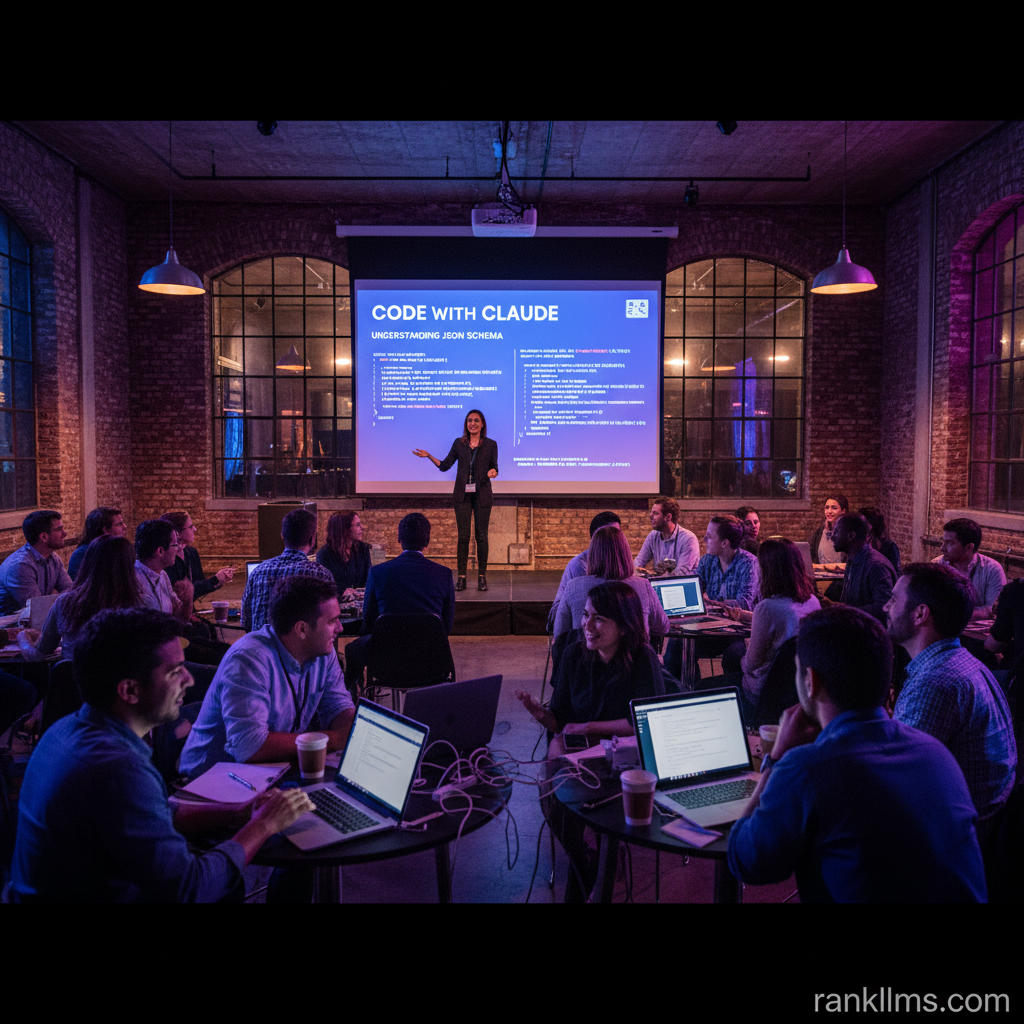
Scaling development with Claude Code speeds up engineering teams by embedding AI into code review, generation, and orchestration while preserving governance and developer workflows.
Intro
Quick answer (one-line featured-snippet friendly answer)
Scaling development with Claude Code speeds up engineering teams by embedding AI into code review, generation, and orchestration while preserving governance and developer workflows.
Why this post matters
- Who this is for: engineering leaders, developer advocates, CTOs, and AI-native startups exploring Anthropic developer tools and looking to scale engineering with Claude Code.
- Core promise: an actionable playbook and proven patterns to scale software development using Claude Code without sacrificing safety, traceability, or developer experience.
- Target keywords to watch: scaling development with Claude Code, AI software engineering workflows, enterprise AI adoption, Anthropic developer tools, AI-native startups.
Featured-snippet-ready summary
- What: Concrete ways teams use Claude Code to automate tasks, augment engineers, and standardize review and testing.
- Why: Faster delivery, higher developer productivity, and consistent outputs when paired with retrieval and governance.
- How (top 3 tactics): Retrieval-augmented generation (RAG) with citations, tiered access controls, continuous red‑teaming and monitoring.
Background
What is Claude Code and where it fits
Claude Code is Anthropic’s developer-focused toolset for coding assistance and AI-driven workflows—designed to plug into editors, CI/CD pipelines, and internal tooling. Think of it as a set of APIs and integrations that bring Claude’s language capabilities directly into developer loops for code generation, review, and orchestration. Compared to GPT-class models and open-weight alternatives, Claude Code emphasizes developer tooling, safety primitives, and enterprise-friendly deployment options (see Anthropic’s product discussions for context) (https://claude.com/blog/code-with-claude-san-francisco-london-tokyo, https://claude.com/blog/product-management-on-the-ai-exponential).
Key concepts you need to know
- AI software engineering workflows: automating code generation, assisted code review, automated test generation, and CI/CD integration. Claude Code becomes part of the pipeline—editor plugins, PR bots, and CI hooks.
- Retrieval-augmented generation (RAG) and citation-first outputs: surface exact source documents and line citations so generated code and rationale are traceable.
- Tiered access controls and private deployments: enable enterprise AI adoption by restricting capabilities (deploy/delete/secret access) to verified roles and secure environments.
Quick context: risks and guardrails
- Typical risks: hallucination, data leakage, bias, and supply-chain concerns.
- Core mitigations:
- provenance and watermarking (trace outputs to source),
- opt-in privacy modes and private-cloud deployments,
- UI signals for uncertainty (flag likely hallucinations),
- continuous red-team testing and scheduled benchmarks to expose failure modes early.
Trend
Why now: adoption signals and industry momentum
Enterprises and AI-native startups are accelerating adoption of Anthropic developer tools as governance and deployment options mature. Large LLMs reached tens of millions of users quickly in consumer contexts; enterprises are mirroring that speed internally once governance is in place. The rise of instruction tuning, RAG, and stronger red-team practices has created an environment where teams can safely integrate AI into software engineering workflows without sacrificing control (examples and product context discussed by Anthropic) (https://claude.com/blog/product-management-on-the-ai-exponential).
Common adoption patterns observed
- Pilot → internal tooling → product features: organizations commonly pilot Claude Code in a single team, move to platform-level integrations (PR bots, CI hooks), and then allow product teams to embed AI-generated capabilities directly in user-facing features.
- Centralized AI platform teams: these teams own model access, provenance, cost controls, and policy gates for developers.
- Developer-first integrations: emphasis on editor plugins, CI hooks, and PR automation—this minimizes workflow disruption for engineers.
Data points & quotes
- Fast adoption example: consumer LLMs reached tens of millions of users in months; enterprises show similar internal uptake with governance in place.
- Snapshot list of standard patterns: RAG, tiered access, watermarking, UI uncertainty indicators, continuous red-team evaluations (see Anthropic’s product coverage for how developer tools align with these patterns) (https://claude.com/blog/code-with-claude-san-francisco-london-tokyo).
Insight
Practical patterns for scaling development with Claude Code
- Pattern 1 — AI-augmented coding loops
- How: pair Claude Code with editor plugins and CI to generate, lint, and test code snippets. Example: a VS Code extension that generates test stubs and runs them in CI before a human review.
- Benefit: reduces routine work and increases throughput for experienced engineers.
- Pattern 2 — Retrieval + citation-first outputs
- How: use RAG to attach source docs and linkable citations to generated code or design rationale.
- Benefit: improves traceability for audits and makes hallucinations easier to debug.
- Pattern 3 — Tiered access and capability gating
- How: restrict high-risk actions (deployments, secrets access) behind role-based gates and verified workflows.
- Benefit: lowers blast radius and accelerates enterprise AI adoption.
- Pattern 4 — Continuous red‑teaming and benchmarking
- How: run automated fuzz tests, schedule external red-team reviews, and publish internal benchmarks.
- Benefit: exposes failure modes before they reach production.
- Pattern 5 — Privacy-preserving modes for sensitive workloads
- How: ephemeral sessions, on-prem inference, or encrypted context windows for PII and secrets.
- Benefit: reduces regulatory friction in regulated industries.
Analogy: Treat Claude Code like a power tool in a workshop—when used with safety guards (tiered access), documentation (RAG/citations), and regular inspections (red-teaming), it multiplies productivity; used without those safeguards it increases risk.
Implementation checklist (copyable)
1. Choose deployment mode: hosted vs private-cloud.
2. Integrate Claude Code into editor and CI pipelines.
3. Implement RAG with citation-first outputs.
4. Add role-based and capability-based access controls.
5. Schedule automated tests and red-team cycles.
6. Monitor outputs with provenance and watermarking where available.
Case study vignette
An AI-native startup integrated Claude Code to auto-generate PR descriptions and starter unit tests. They paired RAG against internal docs for dependencies and wired a gated CI step that required a human to approve any deploy. The result: review time dropped by ~40% while governance (access and provenance) remained centralized—showing how developer productivity gains and enterprise controls can coexist.
Forecast
3-year outlook for scaling development with Claude Code
1. Mainstreaming of AI platform teams — expect more organizations to centralize Anthropic developer tools, cost controls, and security policies.
2. Standardization of provenance and citation-first outputs — watermarking and citation-first formats will likely be expected parts of enterprise AI adoption.
3. Deeper editor and CI/CD native integrations — Claude Code will be more deeply embedded in developer tools, reducing friction for AI-assisted workflows.
4. Regulatory and compliance alignment — enterprises will demand audit trails and documented risk assessments to meet emerging regulations.
Quick wins vs long bets
- Quick wins: generate boilerplate code, automated unit tests, PR summarization, triage automation.
- Long bets: model-provenance standards, on-prem fine-tuning, full AI-driven release orchestration.
Signals to watch (KPIs)
- Time-to-merge and cycle time improvements.
- Percentage of PRs touched by AI tools and rollback frequency.
- Incidents tied to hallucinations or data leaks.
CTA
Actionable next steps (for engineering leaders)
- Try a small, measurable pilot: integrate Claude Code into one repo’s PR workflow for automated tests and summaries.
- Create an internal AI playbook: define access tiers, telemetry, red-team cadence, and rollback procedures.
- Measure impact: track developer time saved, defect rates, and mean time to recovery.
Resources and follow-ups
- Suggested assets to produce: a one-pager playbook, a sample CI integration repo, a red-team checklist, and a privacy decision matrix.
- Internal stakeholders to involve: platform engineers, security, legal/compliance, and product managers.
- Further reading: Anthropic’s product discussions and events on developer tooling provide useful context (https://claude.com/blog/product-management-on-the-ai-exponential, https://claude.com/blog/code-with-claude-san-francisco-london-tokyo).
Suggested meta & SEO elements
- Meta description (120–155 chars): \”Practical playbook for scaling development with Claude Code — integrate Anthropic developer tools into CI, RAG, governance, and red‑teaming.\”
- Suggested slug: scaling-development-claude-code-playbook
- Suggested featured image concept: developer at laptop with flow diagram showing Claude Code in CI, RAG, and governance layer.
FAQ (featured-snippet optimized)
#### How does Claude Code speed up software development?
By automating repetitive tasks (boilerplate, tests, PR summaries) and surfacing relevant knowledge through RAG, Claude Code reduces time spent on routine engineering work.
#### Is Claude Code safe for enterprise use?
Yes—when combined with private deployments, tiered access controls, provenance tracking, and continuous red‑teaming, Claude Code can be adopted safely as part of enterprise AI adoption.
#### What is the recommended pilot to start scaling development with Claude Code?
Start with PR automation for one repository—auto-generate tests, run AI-assisted code review, and add a human-in-the-loop gated deploy step.
By following these patterns—RAG with citations, capability gating, continuous security testing—teams can accelerate scaling development with Claude Code while keeping governance tight and outcomes traceable.