DeepSeek V4 Flash: Inference Latency, Context Window, and Cost Breakdown
DeepSeek V4 Flash features 284B parameters (13B active), a 1M token context window, and $0.14/$0.28 per million pricing. Here is the technical breakdown.

Synthesizing article benchmarks & model metrics...
With the deployment of DeepSeek V4 Flash, high-throughput language modeling has entered a new phase of economic efficiency. Rather than compressing a dense model into low-parameter approximations, DeepSeek structured V4 Flash as a 284-billion-parameter Mixture-of-Experts (MoE) network that activates only 13 billion parameters per token.
Priced at $0.14 per 1 million input tokens and $0.28 per 1 million output tokens, V4 Flash delivers native 1,000,000-token context processing at roughly one-tenth the cost of legacy small-model APIs like GPT-4o-mini and Claude 3.5 Haiku.
Below is an engineering overview of the architecture, memory compression techniques from arXiv:2606.19348, and practical latency measurements in production environments.
Technical Specifications: DeepSeek V4 Flash
| Specification | DeepSeek V4 Flash Metrics | Architectural Comparison |
|---|---|---|
| Model Type | Sparse Mixture of Experts (MoE) | Dynamic top-k expert routing |
| Total Parameters | 284 Billion | High capacity storage |
| Activated Parameters | 13 Billion per token | Equivalent execution cost to 13B dense |
| Pre-Training Corpus | >32 Trillion Tokens | Shared with V4 Pro series |
| Context Window | 1,000,000 Tokens (1M) | Native long-context attention |
| Maximum Output Length | 384,000 Tokens | Extended generation capability |
| Input Price (Cache Miss) | $0.14 / 1M tokens | 90% cheaper than traditional small APIs |
| Input Price (Cache Hit) | $0.0028 / 1M tokens | Sub-cent prompt caching |
| Output Price | $0.28 / 1M tokens | Predictable high-volume generation |
| Thinking Modes | Hybrid (Thinking & Non-Thinking) | Toggleable reasoning chain |
| Tool Calling & JSON | Native Function Calling | Supported in API and Ollama |
What Actually Changed? Architectural Economics
The central innovation in DeepSeek V4 Flash is the balance between total parametric knowledge (284B) and per-token inference FLOPs (13B):
- Active Compute vs Dense 30B: Because only 13B weights fire during any single forward pass, inference latency mirrors lightweight models, while the 284B parameter pool preserves broad domain facts and specialized syntax.
- Memory Footprint Compression: Using Compressed Sparse Attention (CSA), KV cache footprint across 1M tokens is compressed by 90% relative to standard Multi-Head Attention (MHA).
- Dual Mode Flexibility: In non-thinking mode, V4 Flash functions as an ultra-fast parser and autocomplete engine. In thinking mode, it generates internal chain-of-thought scratchpads before answering complex multi-step problems.
Where DeepSeek V4 Flash Performs Well
- High-Volume Context Processing: In retrieval-augmented generation (RAG) pipelines processing hundreds of PDFs or large logs, the $0.14/1M input pricing reduces API bills by thousands of dollars monthly.
- Fast Agentic Tool Dispatch: Because the model generates tokens at high throughput, it serves as an ideal sub-agent orchestrator for classifying requests, formatting JSON, and verifying lint rules.
- Low-Cost Local Deployment: For enterprise VPC deployments, quantizations of V4 Flash (such as Q4_K_M) fit comfortably across standard dual-GPU setups (2x RTX 4090 or 2x A6000), eliminating cloud vendor lock-in.
Known Trade-offs & Limitations
- Complex Formal Proofs: While thinking mode elevates math and logic accuracy, V4 Flash trails frontier models like DeepSeek V4 Pro and GPT-5.6 Sol on nuanced software architecture and competitive mathematics.
- Thinking Mode Latency Overhead: When reasoning is enabled, time-to-first-token (TTFT) increases as the model deliberates. Workloads requiring sub-200ms latency should explicitly set non-thinking mode.
Related Models & Discovery Resources
- Model Scorecard: Specs and ratings on DeepSeek V4 Flash 0731
- Compare Models: Simulate head-to-head performance in our LLM Comparison Engine
- Global Rankings: View all tracked models on the AI Model Leaderboard
- Catalog Directory: Browse all models in the All Models Directory
RankLLMs independent evaluations verify official benchmarks against reproducible testing suites, community logs, and provider documentation.
- •DeepSeek API Official Pricing & Documentation(Primary Source →)
- •arXiv:2606.19348 Technical Report(Primary Source →)
- •Hugging Face Model Repository(Primary Source →)
Was this benchmark analysis helpful?
Thank you for your feedback! We update our benchmarks weekly based on developer input.
Lucky Yaduvanshi(luckyyaduvanshi.in →)
Founder of RankLLMs • AI Researcher & Software Engineer focusing on LLM benchmarking, DevOps, and autonomous coding agents.
Recommended Reading
Continue exploring related technical benchmarks, model deep-dives, and autonomous coding agent guides.
DeepSeek V4 Flash 0731: Benchmarks, Features, and Inference Speed
DeepSeek V4 Flash 0731: post-training benchmarks across Terminal-Bench (82.7%) and DeepSWE (54.4%), 1M context efficiency, and $0.14/$0.28 token economics.
Lucky Yaduvanshi
Alibaba Model Studio Token Plan: Pricing Structure and Claude Code Integration
Comprehensive review of the Alibaba Cloud Model Studio Token Plan. We break down Singapore region access, Credits math, 7-day rolling limits, night discounts, Reddit community benchmarks, and Claude Code setup.
Lucky Yaduvanshi
Tencent Hy4 Preview: 770B MoE Architecture and 1M Context Window
Detailed analysis of Tencent Hy4 preview: 770B MoE architecture (49B active), 1M context window, Gated DSA attention, benchmark scores, and Apache 2.0 weights.
Lucky Yaduvanshi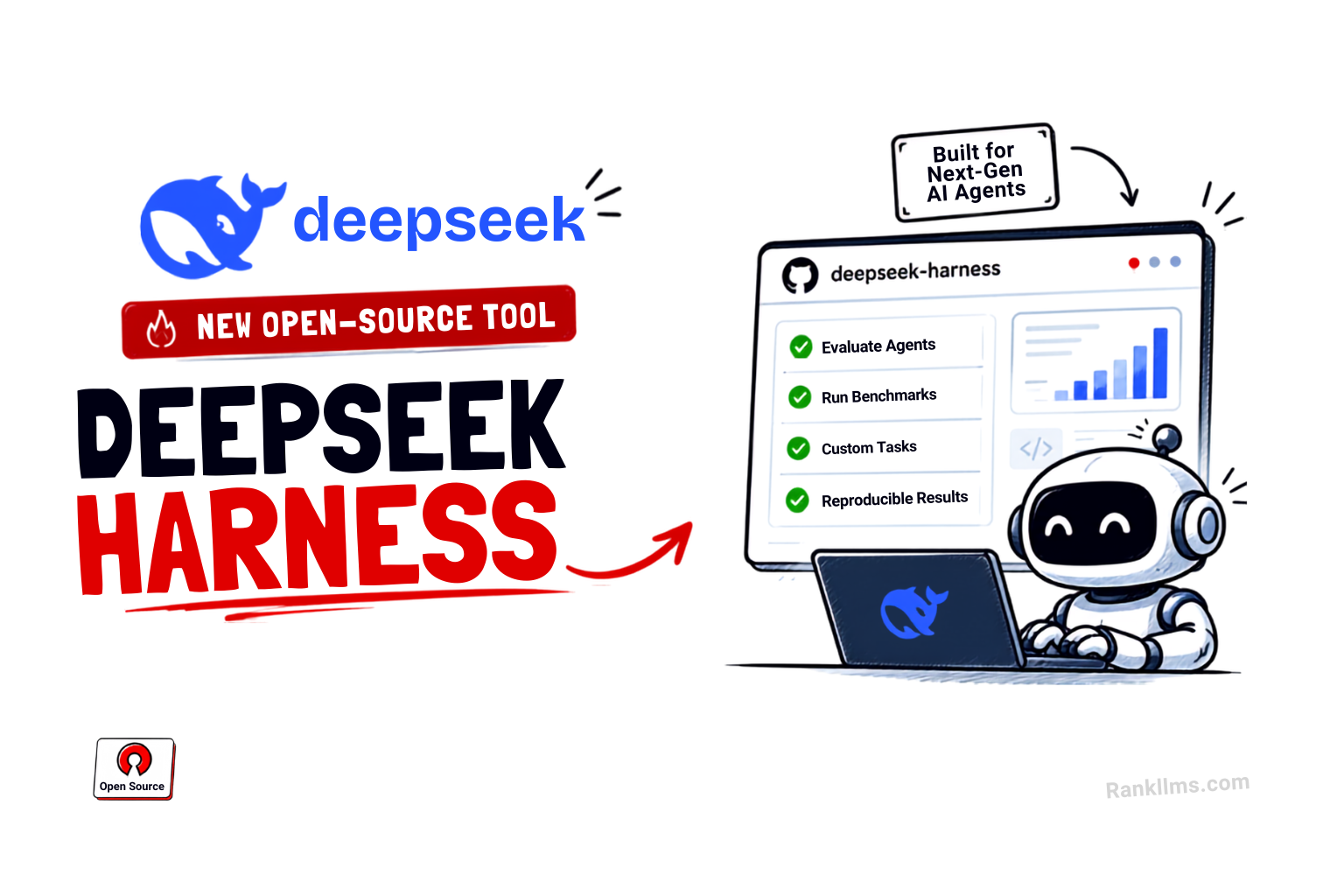
DeepSeek Harness: Architecture, Tool Execution, and Setup Guide
Comprehensive technical guide to DeepSeek Harness (dsh): Cordis micro-kernel architecture, append-only trajectory tracing, pluggable model adapters, and local deployment.
Lucky Yaduvanshi