DeepSeek V4 Pro 0813: Architectural Analysis, Benchmarks, and $0.435/1M Economics
DeepSeek V4 Pro 0813 achieves 87.9 on Terminal-Bench 2.1 using a 1.6T MoE architecture at $0.435/1M tokens. Here is the technical report and benchmark analysis.

Synthesizing article benchmarks & model metrics...
The general availability release of DeepSeek V4 Pro 0813 marks a pivotal milestone for open-weights artificial intelligence. Built on the technical breakthroughs published in DeepSeek’s research report (arXiv:2606.19348), the production build preserves a massive 1.6 trillion parameter Mixture-of-Experts (MoE) architecture while activating only 49 billion parameters per token.
With a native 1,000,000-token context window and an API billing structure of $0.435 per 1M input tokens and $0.87 per 1M output tokens, DeepSeek V4 Pro 0813 challenges the proprietary pricing assumptions of frontier labs.
Below is an engineering analysis of the architecture, empirical benchmark verification against Claude Fable 5 and GPT-5.6 Sol, and practical deployment realities for enterprise infrastructure.
DeepSeek silently released V4-Pro 0813, up 15.8% on Terminal Bench from their April Preview model, with Fable 5 performance at ~57x cheaper cost.
— Cline (@cline/status/2087602193205694891) August 12, 2026
1.6T param, 49B active, 1M context. This is the best price-to-perfomance model on the market right now.
Available in ClinePass now! pic.twitter.com/D9yas0umPn
Architectural Specifications & Core Parameters
| Metric / Parameter | DeepSeek V4 Pro 0813 Specification | Architectural Context |
|---|---|---|
| Foundation Developer | DeepSeek AI | Research group behind V3 and R1 |
| Total Model Parameters | 1.6 Trillion (1,600B MoE) | Sparse routing topology |
| Activated Parameters | 49 Billion per token | Low compute per inference pass |
| Pre-Training Corpus | >32 Trillion Tokens | Multilingual & multi-language code |
| Context Window | 1,000,000 Tokens (1M Standard) | Native long-context attention |
| Input Price (Cache Miss) | $0.435 / 1M tokens | Standard API rate |
| Input Price (Cache Hit) | $0.003625 / 1M tokens | Extreme context caching savings |
| Output Token Price | $0.87 / 1M tokens | ~20x below frontier proprietary rates |
| Terminal-Bench 2.1 | 87.9 | Ties Claude Fable 5 (88.0) |
| DeepSWE Score | 62.7% | Strong multi-file patch generation |
| Cybergym Score | 83.3 | Specialized vulnerability analysis |
| Open Weights License | MIT Permissive | Available on Hugging Face |
What Changed From Early Previews? Calculated Improvements
Compared to the April 2026 Preview snapshot, the 0813 GA release introduces measured optimizations across inference throughput and agentic decision making:
| Evaluation Suite | April 2026 Preview | August 2026 GA (0813) | Net Improvement | Relative Gain |
|---|---|---|---|---|
| Terminal-Bench 2.1 | 75.9 | 87.9 | +12.0 pts | +15.8% relative gain |
| DeepSWE Patching | 56.2% | 62.7% | +6.5 pts | +11.6% relative gain |
| Cybergym Exploits | 74.1 | 83.3 | +9.2 pts | +12.4% relative gain |
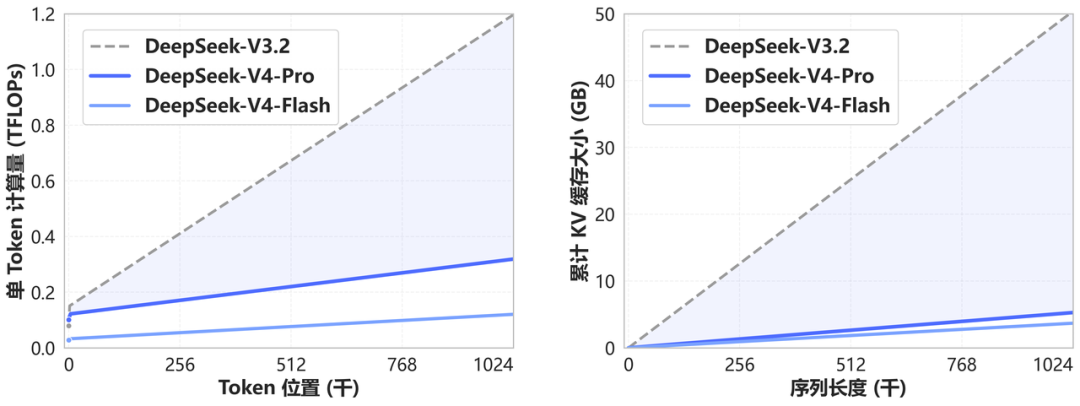
| 1M Context KV Memory | 100% baseline | 10% of V3.2 | -90.0% footprint | 10x memory compression |
| Inference FLOPs / Token | 100% baseline | 27% of V3.2 | -73.0% compute | 3.7x compute efficiency |

Key Architectural Upgrades (arXiv:2606.19348):
- Compressed Sparse Attention (CSA + HCA + DSA): Combines Compressed Sparse Attention and Heavily Compressed Attention alongside DeepSeek Sparse Attention. This reduces KV cache memory consumption across 1 million tokens down to only 10% of traditional attention, making true million-token memory commercially practical.
- Manifold-Constrained Hyper-Connections (mHC): Replaces traditional naive residual additions with manifold-constrained connections. This stabilizes gradient flows across 1,600 billion parameters without layer normalization blowups.
- Muon Optimizer at Scale: DeepSeek utilized the Muon matrix optimizer across the entire 32T token pre-training regime, yielding faster convergence and higher validation accuracy per training FLOP.
Where DeepSeek V4 Pro 0813 Excels
- Interactive Terminal & Tool Automation: Scoring 87.9 on Terminal-Bench 2.1, V4 Pro 0813 matches top frontier systems like Claude Fable 5 (88.0) and Kimi K3 (88.3). It effectively plans shell commands, handles tool execution outputs, and diagnoses build failures.
- Cybersecurity & Red-Teaming (Cybergym 83.3): In defensive and offensive security evaluations, the model exhibits sharp reasoning on memory corruption, exploit payload verification, and code auditing.
- Context Caching Economics: At $0.003625 per 1M cached tokens, storing a 500k-token repository in active memory costs less than 2 cents per query.
Where It Falls Behind & Practical Trade-offs
- Peak Repository Engineering (DeepSWE): At 62.7%, DeepSeek V4 Pro trails proprietary leaders like GPT-5.6 Sol Max (73.0%) and Claude Fable 5 Max (70.0%). While it generates functional patches, it can struggle with subtle semantic regressions in complex Python/C++ codebases.
- Self-Hosting Hardware Requirements: Because the full architecture spans 1.6 trillion weights, self-hosting requires significant enterprise hardware. Running FP8 weights locally requires an 8x H100 or H200 node minimum. Teams seeking pure local inference on single workstations should consult our Open-Source LLM Guide for 30B–70B options.
Related Models & Discovery Resources
- Full Model Profile: Specifications and latency benchmarks on DeepSeek V4 Pro 0813
- Compare Head-to-Head: Match DeepSeek against rivals in the LLM Comparison Engine
- Global Leaderboard: Check rankings on the AI Model Leaderboard
- Coding Guide: Explore our verified evaluation of the Best LLM for Coding in 2026
RankLLMs independent evaluations verify official benchmarks against reproducible testing suites, community logs, and provider documentation.
- •arXiv:2606.19348 Technical Report (Towards Highly Efficient 1M-Token Context)(Primary Source →)
- •DeepSeek AI Official Release Announcement(Primary Source →)
- •Hugging Face Open Weights Repository(Primary Source →)
Was this benchmark analysis helpful?
Thank you for your feedback! We update our benchmarks weekly based on developer input.
Lucky Yaduvanshi(luckyyaduvanshi.in →)
Founder of RankLLMs • AI Researcher & Software Engineer focusing on LLM benchmarking, DevOps, and autonomous coding agents.
Recommended Reading
Continue exploring related technical benchmarks, model deep-dives, and autonomous coding agent guides.
DeepSeek V4 Flash 0731: Benchmarks, Features, and Inference Speed
DeepSeek V4 Flash 0731: post-training benchmarks across Terminal-Bench (82.7%) and DeepSWE (54.4%), 1M context efficiency, and $0.14/$0.28 token economics.
Lucky Yaduvanshi
Grok 4.6: Benchmark Results, Pricing, and What Changed
Grok 4.6 delivers major improvements on coding and agent benchmarks over Grok 4.5 while maintaining $2/$6 per million token pricing. Here is the independent breakdown.
Lucky Yaduvanshi
Best LLMs for Coding in 2026: SWE-bench Verified Data & Cost Math
The best coding LLMs in 2026, ranked by SWE-bench Verified, Terminal Bench, and cost per solved task. Claude Fable 5 leads raw accuracy; Gemini 3.7 Flash and GLM-5.3-Flash lead value.
Lucky Yaduvanshi
Qwen3.8 Flash vs GLM-5.3 Flash: Lightweight Frontier Coding Comparison
Head-to-head comparison of Qwen3.8 Flash and GLM-5.3 Flash: coding benchmarks, tool use, throughput latency, and per-token pricing.
Lucky Yaduvanshi