Zed Pro 14-Day Free Trial Analysis: $20 Hosted AI Credits, Model Lineup, and Token Economics
Analysis of the Zed Pro 14-day free trial: $20 in hosted AI credits, unlimited edit predictions, Claude Sonnet 4.6, GPT-5.6, and student benefits.


Synthesizing article benchmarks & model metrics...
The Zed Pro free trial provides developers with a 14-day evaluation window featuring $20 in hosted AI credits alongside unlimited accepted edit predictions in a high-performance, Rust-native code editor.
What makes Zed’s trial uniquely compelling is its multi-provider hosted catalog: rather than restricting users to a single proprietary foundation model, Zed hosts frontier models from Anthropic, OpenAI, and Google, allowing developers to compare Claude Sonnet 4.6, GPT-5.6 Sol, and Gemini 3.1 Pro directly within their everyday workflow.
However, extracting maximum utility from the $20 balance requires understanding Zed’s token metering architecture, hosted markups, and specific model exclusions.
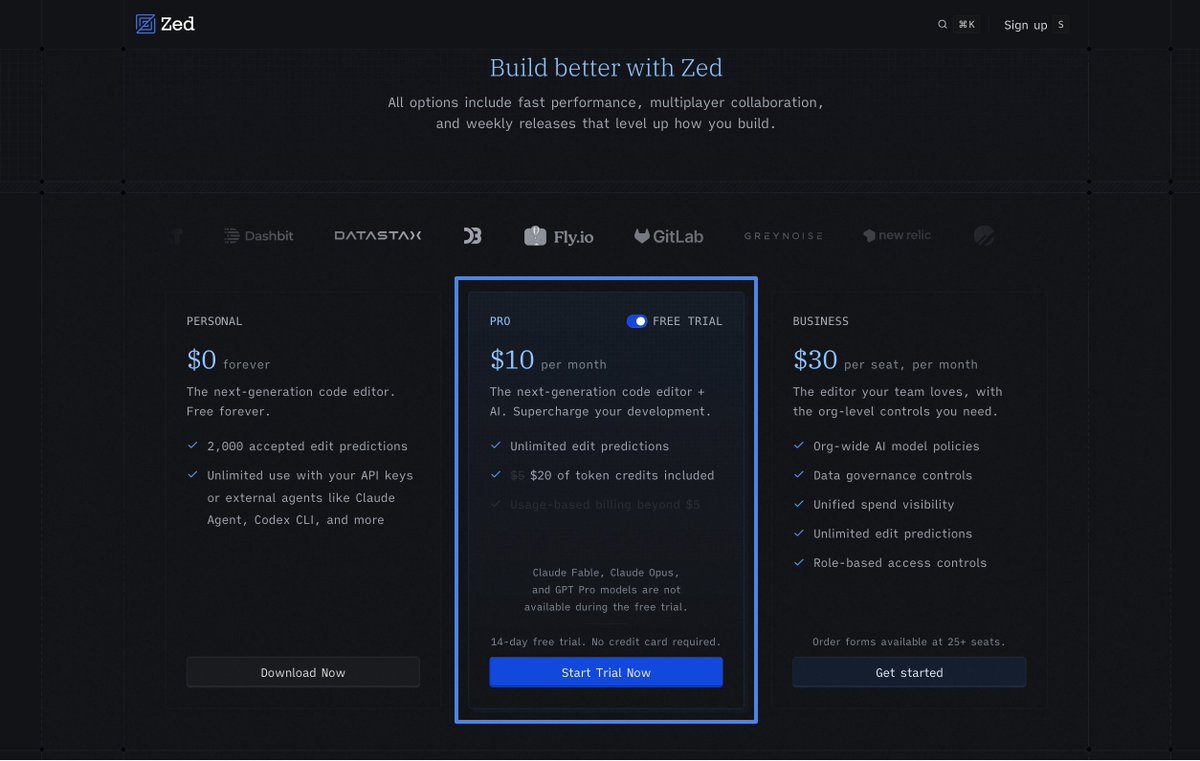
Trial Summary & Core Feature Matrix
| Feature | Zed Pro Free Trial | Standard Zed Free Tier | Zed Pro ($10/mo) |
|---|---|---|---|
| Duration | 14 Calendar Days | Unlimited | Monthly Subscription |
| Hosted AI Credit | $20.00 Total | $0.00 | $5.00 / month included |
| Inline Edit Predictions | Unlimited | Basic | Unlimited |
| Hosted Model Access | Yes (Anthropic, OpenAI, Google) | BYOK Only | Yes |
| Claude Opus Access | Excluded from Trial | N/A | Available (Metered) |
| Bring-Your-Own-Key | Supported | Supported | Supported |
| Student Offering | N/A | N/A | Free for 1 Year ($10/mo credits) |
Zed Hosted Model Pricing: Understanding the Token Burn
Zed hosts models on its own infrastructure with a published 10% markup over base provider list prices. Because billing is strictly metered per token, your $20 trial balance burns at radically different rates depending on model selection:
| Model | Input Rate / 1M | Output Rate / 1M | Context Window | Workload Cost (1M In + 100K Out) | $20 Credit Workload Capacity |
|---|---|---|---|---|---|
| Claude Sonnet 5 | $2.20 | $11.00 | 1,000,000 | $3.30 | ~6.06 Sessions |
| Claude Sonnet 4.6 | $3.30 | $16.50 | 1,000,000 | $4.95 | ~4.04 Sessions |
| GPT-5.6 Sol | $5.50 | $33.00 | 400,000 | $8.80 | ~2.27 Sessions |
| GPT-5.6 Terra | $2.75 | $16.50 | 400,000 | $4.40 | ~4.54 Sessions |
| Claude Haiku 4.5 | $1.10 | $5.50 | 200,000 | $1.65 | ~12.12 Sessions |
| Gemini 3.5 Flash | $1.65 | $9.90 | 1,000,000 | $2.64 | ~7.57 Sessions |
| GPT-5 nano | $0.055 | $0.44 | 400,000 | $0.099 | ~202.0 Sessions |
Strategic Takeaways for Maximizing the $20 Credit:
- Frontier Model Reservations: Running GPT-5.6 Sol burns through the trial in barely two large codebase refactors. Reserve Sol or Sonnet 4.6 for complex architectural changes and subtle multi-file bug diagnosis.
- Day-to-Day Editing: Claude Haiku 4.5 and Gemini 3.5 Flash provide excellent reasoning for routine edits at a fraction of the cost, extending the trial across dozens of working sessions.
- Inline Transformations: For unit test generation or boilerplate scaffolding, GPT-5 nano allows over 200 full-scale editing passes within the $20 allocation.
Editor Architecture: Why Zed Matters for AI Workflows
Zed is not an Electron shell or a VS Code fork; it is written from scratch in Rust using the GPUI vector graphics framework, delivering sub-10ms frame rendering and instant file navigation:
graph TD
    A[Zed Rust Core & GPUI Framework] --> B[Integrated AI Assistant]
    B -->|Hosted Model Gateway| C[Anthropic / OpenAI / Google Models]
    B -->|Local Engine| D[Sub-20ms Edit Predictions]
    B -->|External Agents| E[MCP / Custom Agentic Tools]
    A --> F[Multiplayer Collaboration & CRDTs]
- Zero-Latency Autocomplete: Edit predictions are rendered asynchronously without blocking the main text rendering thread.
- External Agent Protocol Support: Zed includes native support for external agent scaffolds and the Model Context Protocol (MCP), enabling external CLI tools to interact directly with open buffers.
- Real-Time Multiplayer Collaboration: Teams can co-edit files while sharing context sessions with active AI agents.
The Zed Student Program: 1 Year Free Access
For university students, Zed offers one of the most generous education programs in the developer space:
- Duration: One full calendar year of Zed Pro at $0.00.
- Monthly Token Allowance: $10 per month in hosted AI credits (a cumulative $120 value).
- Unlimited Predictions: Uncapped access to Zed’s inline edit prediction models.
- Verification: Authenticated through GitHub Education or active institutional email validation.
Students evaluating coding options should also explore the ChatGPT Plus 4-Month Student Promotion.
How to Activate the Zed Pro Free Trial
- Download the Zed editor from the official Zed Release Channel.
- Open the editor and authenticate using your GitHub profile.
- In the command palette (
Cmd+Shift+PorCtrl+Shift+P), selectzed: open account settings. - Click
Start Zed Pro Trial. The $20.00 hosted credit is immediately applied to your active profile. - In the assistant panel (
Cmd+?), open model settings and select your preferred default reasoning engine.
Related Developer Promotions & Model Guides
- Fireworks AI $6 Free Credits: Up to 214M tokens of DeepSeek V4 Flash for testing API-driven agent pipelines.
- AMD AI Developer Program: $50 in serverless credits for DeepSeek, MiniMax, and Kimi K3.
- Coding Plans & Subscriptions Matrix: Compare Zed Pro against GitHub Copilot, Cursor Pro, Claude Pro, and ChatGPT Plus.
- AI Model Leaderboard: Up-to-date benchmarks on reasoning, speed, and token cost across all frontier LLMs.
RankLLMs Technical Verdict
The Zed Pro free trial is an outstanding platform for developers looking to compare multiple frontier coding models inside a modern, high-speed development environment.
By delivering $20 in hosted credits, unlimited edit predictions, and an open BYOK escape hatch, Zed gives developers the exact empirical data needed to decide which model family delivers optimal developer ergonomics for their specific stack.
RankLLMs independent evaluations verify official benchmarks against reproducible testing suites, community logs, and provider documentation.
- •Zed Industries: Plans and Pricing(Primary Source →)
- •Zed Documentation: Hosted AI Models & Pricing Matrix(Primary Source →)
- •Zed for Education: Student Program(Primary Source →)
Was this benchmark analysis helpful?
Thank you for your feedback! We update our benchmarks weekly based on developer input.
Lucky Yaduvanshi(luckyyaduvanshi.in →)
Founder of RankLLMs • AI Researcher & Software Engineer focusing on LLM benchmarking, DevOps, and autonomous coding agents.
Recommended Reading
Continue exploring related technical benchmarks, model deep-dives, and autonomous coding agent guides.
TypeSafe AI Jev Access Guide: Free Trial Endpoints, API Pricing, and System One Architecture
How to access TypeSafe AI's Jev model for free: Vercel AI Gateway promotion, OpenRouter pricing at $0.042/1M tokens, latency benchmarks, and System One design.
Lucky Yaduvanshi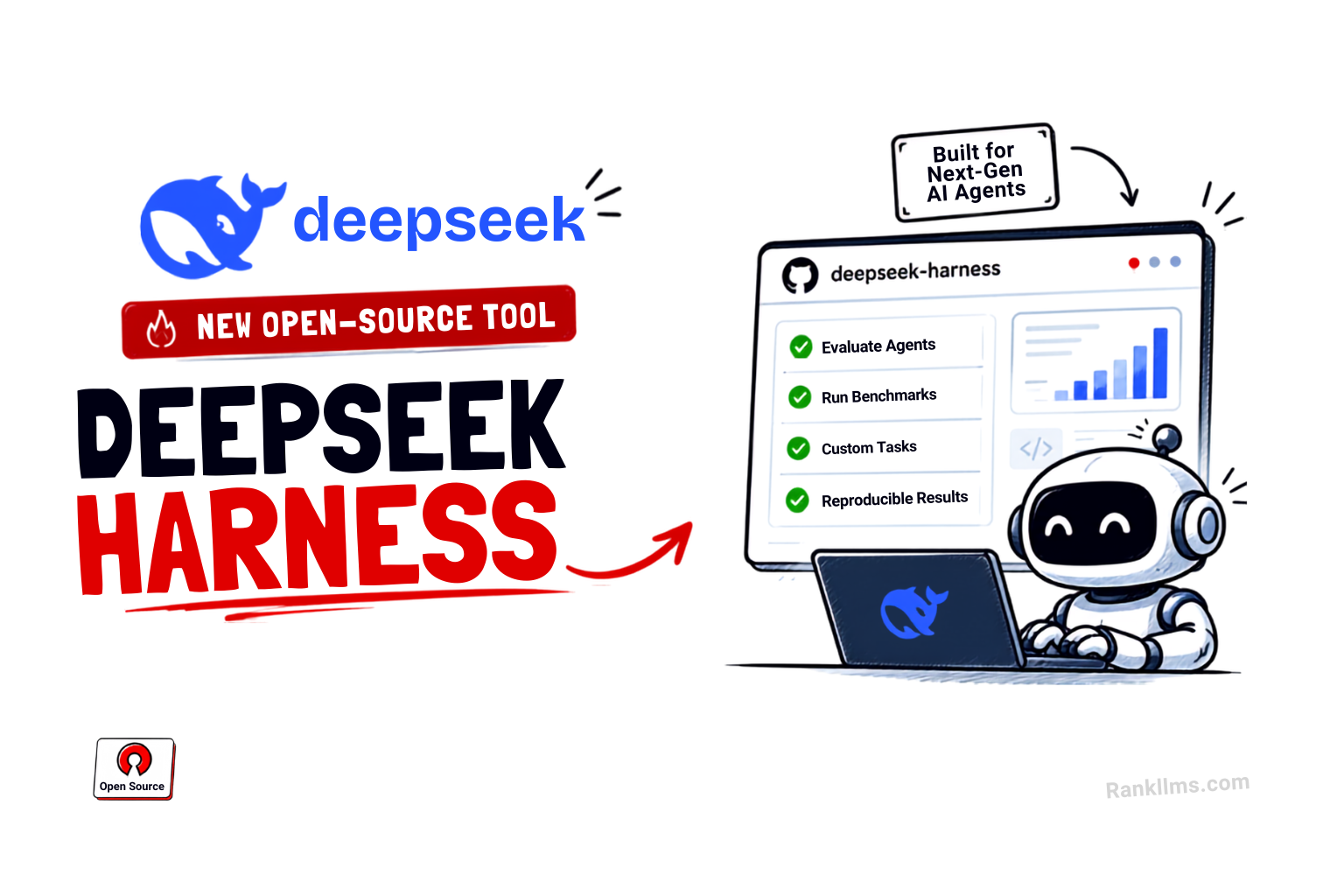
DeepSeek Harness: Architecture, Tool Execution, and Setup Guide
Comprehensive technical guide to DeepSeek Harness (dsh): Cordis micro-kernel architecture, append-only trajectory tracing, pluggable model adapters, and local deployment.
Lucky Yaduvanshi
GLM-5.3-FlashX: 200 Tokens/sec Throughput vs 2.5x Price Analysis
In-depth review of GLM-5.3-FlashX: 200 tokens/second inference throughput, latency benchmarks, and whether the 2.5x pricing premium is justified.
Lucky YaduvanshiTypeSafe AI Jev Architectural Deep Dive: System One Decision Models vs Generative LLMs
Why TypeSafe AI's Jev model captured 13% of Vercel AI Gateway teams in 24 hours. Deep dive into RLCD training, 70ms decision latency, and architecture.
Lucky Yaduvanshi