DeepSeek V4 Pro 0813: Architectural Analysis, Benchmarks, and $0.435/1M Economics
DeepSeek V4 Pro 0813 achieves 87.9 on Terminal-Bench 2.1 using a 1.6T MoE architecture at $0.435/1M tokens. Here is the technical report and benchmark analysis.

Synthesizing article benchmarks & model metrics...
The general availability release of DeepSeek V4 Pro 0813 marks a pivotal milestone for open-weights artificial intelligence. Built on the technical breakthroughs published in DeepSeek’s research report (arXiv:2606.19348), the production build preserves a massive 1.6 trillion parameter Mixture-of-Experts (MoE) architecture while activating only 49 billion parameters per token.
With a native 1,000,000-token context window and an API billing structure of $0.435 per 1M input tokens and $0.87 per 1M output tokens, DeepSeek V4 Pro 0813 challenges the proprietary pricing assumptions of frontier labs.
Below is an engineering analysis of the architecture, empirical benchmark verification against Claude Fable 5 and GPT-5.6 Sol, and practical deployment realities for enterprise infrastructure.
DeepSeek silently released V4-Pro 0813, up 15.8% on Terminal Bench from their April Preview model, with Fable 5 performance at ~57x cheaper cost.
— Cline (@cline/status/2087602193205694891) August 12, 2026
1.6T param, 49B active, 1M context. This is the best price-to-perfomance model on the market right now.
Available in ClinePass now! pic.twitter.com/D9yas0umPn
Architectural Specifications & Core Parameters
| Metric / Parameter | DeepSeek V4 Pro 0813 Specification | Architectural Context |
|---|---|---|
| Foundation Developer | DeepSeek AI | Research group behind V3 and R1 |
| Total Model Parameters | 1.6 Trillion (1,600B MoE) | Sparse routing topology |
| Activated Parameters | 49 Billion per token | Low compute per inference pass |
| Pre-Training Corpus | >32 Trillion Tokens | Multilingual & multi-language code |
| Context Window | 1,000,000 Tokens (1M Standard) | Native long-context attention |
| Input Price (Cache Miss) | $0.435 / 1M tokens | Standard API rate |
| Input Price (Cache Hit) | $0.003625 / 1M tokens | Extreme context caching savings |
| Output Token Price | $0.87 / 1M tokens | ~20x below frontier proprietary rates |
| Terminal-Bench 2.1 | 87.9 | Ties Claude Fable 5 (88.0) |
| DeepSWE Score | 62.7% | Strong multi-file patch generation |
| Cybergym Score | 83.3 | Specialized vulnerability analysis |
| Open Weights License | MIT Permissive | Available on Hugging Face |
What Changed From Early Previews? Calculated Improvements
Compared to the April 2026 Preview snapshot, the 0813 GA release introduces measured optimizations across inference throughput and agentic decision making:
| Evaluation Suite | April 2026 Preview | August 2026 GA (0813) | Net Improvement | Relative Gain |
|---|---|---|---|---|
| Terminal-Bench 2.1 | 75.9 | 87.9 | +12.0 pts | +15.8% relative gain |
| DeepSWE Patching | 56.2% | 62.7% | +6.5 pts | +11.6% relative gain |
| Cybergym Exploits | 74.1 | 83.3 | +9.2 pts | +12.4% relative gain |
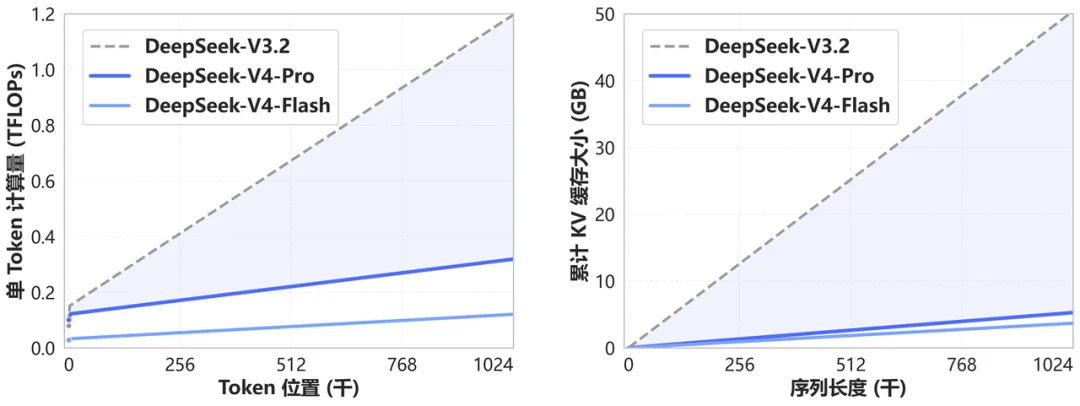
| 1M Context KV Memory | 100% baseline | 10% of V3.2 | -90.0% footprint | 10x memory compression |
| Inference FLOPs / Token | 100% baseline | 27% of V3.2 | -73.0% compute | 3.7x compute efficiency |

Key Architectural Upgrades (arXiv:2606.19348):
- Compressed Sparse Attention (CSA + HCA + DSA): Combines Compressed Sparse Attention and Heavily Compressed Attention alongside DeepSeek Sparse Attention. This reduces KV cache memory consumption across 1 million tokens down to only 10% of traditional attention, making true million-token memory commercially practical.
- Manifold-Constrained Hyper-Connections (mHC): Replaces traditional naive residual additions with manifold-constrained connections. This stabilizes gradient flows across 1,600 billion parameters without layer normalization blowups.
- Muon Optimizer at Scale: DeepSeek utilized the Muon matrix optimizer across the entire 32T token pre-training regime, yielding faster convergence and higher validation accuracy per training FLOP.
Where DeepSeek V4 Pro 0813 Excels
- Interactive Terminal & Tool Automation: Scoring 87.9 on Terminal-Bench 2.1, V4 Pro 0813 matches top frontier systems like Claude Fable 5 (88.0) and Kimi K3 (88.3). It effectively plans shell commands, handles tool execution outputs, and diagnoses build failures.
- Cybersecurity & Red-Teaming (Cybergym 83.3): In defensive and offensive security evaluations, the model exhibits sharp reasoning on memory corruption, exploit payload verification, and code auditing.
- Context Caching Economics: At $0.003625 per 1M cached tokens, storing a 500k-token repository in active memory costs less than 2 cents per query.
Where It Falls Behind & Practical Trade-offs
- Peak Repository Engineering (DeepSWE): At 62.7%, DeepSeek V4 Pro trails proprietary leaders like GPT-5.6 Sol Max (73.0%) and Claude Fable 5 Max (70.0%). While it generates functional patches, it can struggle with subtle semantic regressions in complex Python/C++ codebases.
- Self-Hosting Hardware Requirements: Because the full architecture spans 1.6 trillion weights, self-hosting requires significant enterprise hardware. Running FP8 weights locally requires an 8x H100 or H200 node minimum. Teams seeking pure local inference on single workstations should consult our Open-Source LLM Guide for 30B–70B options.
Related Models & Discovery Resources
- Full Model Profile: Specifications and latency benchmarks on DeepSeek V4 Pro 0813
- Compare Head-to-Head: Match DeepSeek against rivals in the LLM Comparison Engine
- Global Leaderboard: Check rankings on the AI Model Leaderboard
- Coding Guide: Explore our verified evaluation of the Best LLM for Coding in 2026
Benchmark and pricing data is aggregated from OpenRouter, Artificial Analysis, and models.dev, then scored with the published RankLLMs Index. These are the primary sources behind the numbers in this article.
- •arXiv:2606.19348 Technical Report (Towards Highly Efficient 1M-Token Context)(Primary Source →)
- •DeepSeek AI Official Release Announcement(Primary Source →)
- •Hugging Face Open Weights Repository(Primary Source →)
Lucky Yaduvanshi(luckyyaduvanshi.in →)
Founder of RankLLMs • AI Researcher & Software Engineer focusing on LLM benchmarking, DevOps, and autonomous coding agents.
Recommended Reading
Continue exploring related technical benchmarks, model deep-dives, and autonomous coding agent guides.
DeepSeek V4 Flash 0731: Benchmarks, Features, and Inference Speed
DeepSeek V4 Flash 0731: post-training benchmarks across Terminal-Bench (82.7%) and DeepSWE (54.4%), 1M context efficiency, and $0.14/$0.28 token economics.
Lucky Yaduvanshi
Grok 4.6: Benchmark Results, Pricing, and What Changed
Grok 4.6 delivers major improvements on coding and agent benchmarks over Grok 4.5 while maintaining $2/$6 per million token pricing. Here is the independent breakdown.
Lucky Yaduvanshi
Best LLMs for Coding in 2026: SWE-bench Verified Data & Cost Math
The best coding LLMs in 2026, ranked by SWE-bench Verified, Terminal Bench, and cost per solved task. Claude Fable 5 leads raw accuracy; Gemini 3.7 Flash and GLM-5.3-Flash lead value.
Lucky Yaduvanshi
Qwen3.8 Flash vs GLM-5.3 Flash: Lightweight Frontier Coding Comparison
Head-to-head comparison of Qwen3.8 Flash and GLM-5.3 Flash: coding benchmarks, tool use, throughput latency, and per-token pricing.
Lucky Yaduvanshi