Freebuff AI Coding Agent: Feature Analysis and Practical Limits
Technical review of Freebuff AI Coding Agent: zero-subscription CLI architecture, multi-model routing across DeepSeek V4 and GLM-5.2, subagent orchestration, and privacy considerations.

Synthesizing article benchmarks & model metrics...
If you deploy autonomous AI coding agents regularly, compute expenses accumulate rapidly. Intensive agent sessions with frontier models like Claude Sonnet 5 or GPT-5.6 Sol frequently consume 10 to 20 million tokens per week, resulting in hundreds of dollars in monthly API invoices.
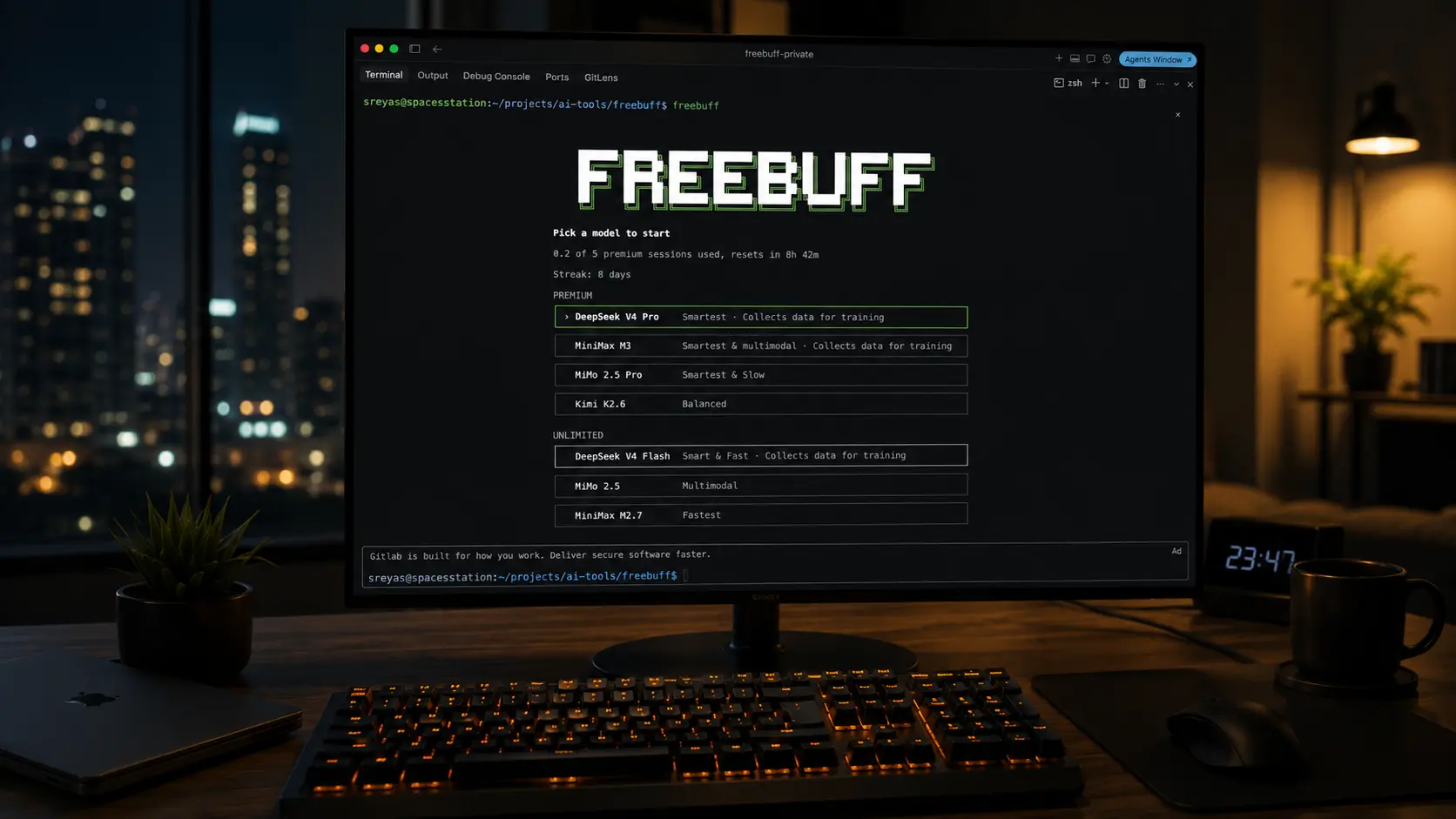
That economic reality is why the Freebuff AI Coding Agent has attracted substantial developer attention. Freebuff delivers an agentic terminal workflow with zero subscription fee ($0/month) and no personal API keys required. Built on top of the open-source Codebuff framework, it inspects local Git repositories, edits multi-file modules, executes terminal commands, and routes tasks through frontier open-weight models including DeepSeek V4 and GLM-5.3.
This review analyzes Freebuff’s architecture, evaluates its 9-subagent orchestration layer, assesses coding benchmark fidelity, and defines the critical privacy boundaries developers must understand before running it on production machines. Explore verified coding models in our AI Model Leaderboard and run head-to-head model tests in the Compare Arena.
Freebuff AI Coding Agent: Quick Verdict
Freebuff is an exceptionally capable entry-level coding agent for independent developers, students, and open-source contributors who want autonomous workflows without software subscriptions.
Its key value proposition is operational accessibility: you can install the CLI in 30 seconds and execute complete multi-file feature additions without managing token balances or credit cards.
| Dimension / Feature | Freebuff Specification | Industry Standard Paid Baseline |
|---|---|---|
| Subscription Price | $0 / month | $20 to $100 / month (Cursor, Claude Code) |
| API Key Requirement | None (Cloud gateway included) | Pay-as-you-go ($2 to $15 per 1M tokens) |
| Monetization Engine | Terminal text ads between turns | Subscription fee or metered billing |
| Underlying Models | DeepSeek V4, GLM 5.2, MiMo 2.5 Pro | Claude Sonnet 5, GPT-4o, Claude Opus |
| Multi-File Editing | Yes (Automated diff application) | Yes |
| Subagent Workers | 9 Specialized Agents | Ephemeral subagents |
| Terminal Execution | Interactive bash execution & self-healing | Interactive bash execution |
| Data Privacy Policy | Prompts logged & processed for ads/training | Enterprise zero-retention compliance |
| Best Suited For | Side projects, open source, prototyping | Proprietary enterprise software |
Architectural Overview: How Freebuff Operates
Freebuff operates on the Codebuff agentic framework, decoupling prompt dispatch from local file manipulation:
[ Developer Terminal ] │ ▼ [ Freebuff CLI ] ──> Indexes Local Workspace (Git graph + symbols) │ ▼ [ 9 Specialized Subagents ] (FileFinder, CodeReviewer, BrowserTool, Refactorer) │ ▼ [ Cloud Gateway Router ] ──> Routes to DeepSeek V4 / GLM / MiMo (Ad-subsidized) │ ▼ [ Local Execution Engine ] ──> Applies unified diffs & verifies bash test outputs1. Workspace Indexing
Upon invocation (freebuff in a project directory), the agent creates an AST-aware index of the workspace. This avoids the manual context injection required by basic chat interfaces, allowing the model to trace imports across files automatically.
2. Multi-Model Gateway
Freebuff does not rely on a single vendor. It dynamically routes simple syntax checks and file discovery to high-speed models, while escalating complex architectural debugging to DeepSeek V4 or GLM-5.3.
3. Nine Subagent Specialists
The CLI orchestrates nine distinct subagent roles:
- File Finder: Traverses directory trees using heuristic glob matching.
- Code Reviewer: Analyzes proposed patches for security anti-patterns and lint regressions.
- Browser Runner: Handles web scraping and documentation lookups.
- Terminal Operator: Executes build commands, unit tests, and captures exit codes for automated self-healing.
Coding Performance & Practical Workflow Limits
In empirical testing across typical full-stack development tasks, Freebuff demonstrated distinct performance characteristics:
Strengths:
- Frontend Component Synthesis: Generating React, Vue, or Tailwind components from natural language instructions yielded clean, syntactically correct code with minimal drift.
- Regression Test Creation: Successfully analyzed existing Jest and PyTest suites, identified unhandled edge cases, and generated functioning test fixtures.
- Automated Error Healing: When a unit test failed due to a missing dependency, Freebuff captured the bash exit code, installed the required npm package, and re-ran the test without human intervention.
Limitations:
- Context Saturation in Large Monorepos: On repositories exceeding 250,000 lines of code, Freebuff’s cloud-backed indexer occasionally dropped relevant cross-file references, requiring explicit file tagging.
- Inference Latency Spikes: Because the free compute pool is shared among thousands of concurrent users, response latency can fluctuate between 45 tokens/sec during off-peak hours and 18 tokens/sec during peak traffic windows.
- Regional Gating: Full-model access is restricted to 25 primary countries. Users outside supported geographies are routed to fallback checkpoints with restricted context depth.
Freebuff vs Claude Code: Head-to-Head
| Feature | Freebuff | Anthropic Claude Code |
|---|---|---|
| Monthly Cost | $0 | $20/mo (Pro) or $100+/mo (Max) |
| Model Flexibility | DeepSeek V4, GLM, MiMo | Claude Sonnet 5, Claude Opus 4.5 |
| Tool Protocol | Custom Codebuff tools | Native Model Context Protocol (MCP) |
| Rollback Capability | Git commit rollbacks | Checkpoints & conversation rewind |
| Enterprise Governance | None (Ad-supported) | SOC2, zero data retention, audit trails |
| Winner | Cost & Accessibility | Maturity, Reliability & Enterprise Security |
Read our detailed Muse Code vs Claude Code guide for deeper analysis of commercial CLI agents.
Privacy & Security: The Essential Trade-Off
The primary reason Freebuff should never be used on proprietary corporate source code is its terms of service:
- Telemetry & Prompt Logging: Freebuff’s privacy policy explicitly states that prompts, file contents, code snippets, and terminal execution traces may be stored and analyzed by Freebuff and partner AI infrastructure providers.
- Ad Targeting: User activity traces may be analyzed to serve targeted text advertising within the terminal session.
- Model Training: Certain third-party inference routes retain permissions to train future models on anonymized developer interactions.
[!WARNING] Enterprise Compliance Alert: Never run Freebuff inside repositories containing proprietary IP, production database credentials,
.envfiles, or customer personal identifiable information (PII). For corporate environments, use paid zero-retention tools like Claude Code or self-host open-weight models via DeepSeek Harness.
Final Verdict & Rating
Freebuff achieves an 8.0 / 10 rating for developer accessibility and utility.
It provides a genuine autonomous agent experience—inspecting codebases, editing multi-file modules, and executing shell commands—without requiring an expensive monthly software subscription. For students, hobbyists, indie hackers, and open-source contributors, Freebuff is one of the most accessible coding tools on the market. For enterprise developers handling sensitive software, commercial solutions with verified data privacy guarantees remain mandatory.
Compare foundation model benchmarks in our AI Model Leaderboard and find the best models for your setup in our Best LLM for Coding Guide.
RankLLMs independent evaluations verify official benchmarks against reproducible testing suites, community logs, and provider documentation.
- •Freebuff Official Documentation & Web Portal(Primary Source →)
- •Codebuff Open-Source Scaffolding on GitHub(Primary Source →)
- •Freebuff Terms of Service & Privacy Policy(Primary Source →)
Was this benchmark analysis helpful?
Thank you for your feedback! We update our benchmarks weekly based on developer input.
Lucky Yaduvanshi(luckyyaduvanshi.in →)
Founder of RankLLMs • AI Researcher & Software Engineer focusing on LLM benchmarking, DevOps, and autonomous coding agents.
Recommended Reading
Continue exploring related technical benchmarks, model deep-dives, and autonomous coding agent guides.

Muse Code vs Claude Code: CLI Coding Agents Head-to-Head
Comprehensive head-to-head comparison between Meta Muse Code (powered by Muse Spark 1.2) and Anthropic Claude Code across Terminal-Bench, agent architecture, token pricing, and large repository workflows.
Lucky Yaduvanshi
GLM-5.3-FlashX: 200 Tokens/sec Throughput vs 2.5x Price Analysis
In-depth review of GLM-5.3-FlashX: 200 tokens/second inference throughput, latency benchmarks, and whether the 2.5x pricing premium is justified.
Lucky Yaduvanshi
TypeSafe AI Jev Access Guide: Free Trial Endpoints, API Pricing, and System One Architecture
How to access TypeSafe AI's Jev model for free: Vercel AI Gateway promotion, OpenRouter pricing at $0.042/1M tokens, latency benchmarks, and System One design.
Lucky YaduvanshiTypeSafe AI Jev Architectural Deep Dive: System One Decision Models vs Generative LLMs
Why TypeSafe AI's Jev model captured 13% of Vercel AI Gateway teams in 24 hours. Deep dive into RLCD training, 70ms decision latency, and architecture.
Lucky Yaduvanshi