Muse Glimmer: Meta's 30B Open-Weight Local Agent Model Explained
Meta has released Muse Glimmer, a 30B open-weight model optimized for always-on local agents. Learn how it works, its hardware requirements, agentic capabilities, benchmarks, and Apache 2.0 licensing.

Synthesizing article benchmarks & model metrics...
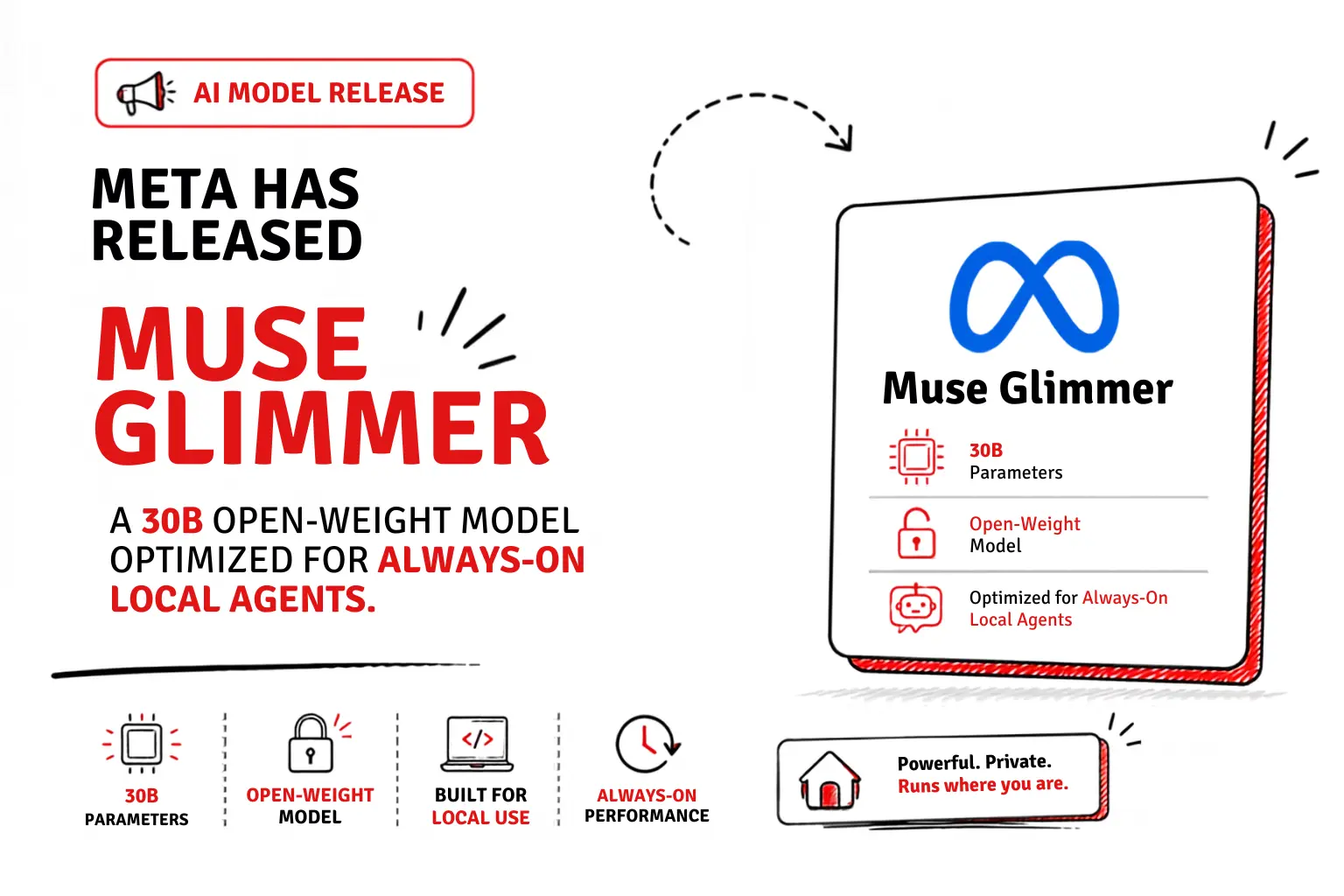
Meta Superintelligence Labs has released Muse Glimmer, a 30-billion-parameter open-weight model designed around a specific problem: making capable AI agents practical on consumer hardware.
Instead of optimizing only for chatbot benchmarks, Muse Glimmer is engineered for always-on local agent workflows involving tool calls, coding, multimodal inputs, long-horizon reasoning, and automated failure recovery.
Meta is releasing the model weights under the Apache 2.0 license, and confirms that the approximately 4-bit quantized version shrinks the language model to under 20 GB (17 GB measured). That makes a 30B model feasible on a single consumer GPU (such as an RTX 4090 or RTX 5090) or Apple Silicon Mac (M4 Max / M5 Max) rather than requiring a cloud inference endpoint. Explore where open-weight models rank on our AI Model Leaderboard and Full LLM Model Directory.
Executive Summary & Core Specification Matrix
| Specification | Muse Glimmer |
|---|---|
| Parameters | 30B |
| Model Type | Dense open-weight model |
| Primary Focus | Local agentic workflows & tool recovery |
| License | Apache 2.0 (Permissive commercial) |
| Multimodal Input | Text + interleaved images |
| Languages Supported | 100+ |
| Quantized Model Size | Under 20 GB (17 GB base weights) |
| Target Memory Envelope | 24 GB / 32 GB |
| Local Hardware Target | Apple Silicon Mac or single consumer GPU |
| Reasoning Control | Controllable thinking effort |
| Tool Execution | Native function calling & schema parsing |
| Failure Recovery | Built-in self-correction loops |
| Speculative Decoding | DFlash-based drafter (up to 3.1x speedup) |
| Weights Availability | Hugging Face, Ollama, LM Studio |
Why Local Agentic AI Is Different
Cloud AI agents offer access to massive data-center clusters, but introduce critical operational dependencies:
- Continuous Internet Connectivity: Agents break on unreliable networks.
- Recurring API Invoices: Autonomous loops consuming 5M+ tokens quickly accumulate thousands of dollars in billing.
- Privacy and Data Locality: Transmitting proprietary codebases, database credentials, and screen captures to third-party endpoints creates enterprise compliance risks.
- Network Latency: Multi-step tool loops incur network latency on every forward pass.
A local Muse Glimmer workflow transforms this topology into a zero-latency, private execution loop:
Cloud Agent Architecture:User ──> Local App ──[Internet]──> AI API ──[Internet]──> Tool Loop ──[Internet]──> Result
Local Muse Glimmer Architecture:User ──> Local App ──[Zero Latency / Local Bus]──> Muse Glimmer (17GB VRAM) ──> Local Tools & Git ──> Result
Muse Glimmer’s Training Strategy: Distillation from Muse Spark
Training a compact 30B model to handle multi-step agent trajectories requires specialized post-training:
- Pre-Training & Logit Distillation: Meta trained Muse Glimmer on outputs from Muse Spark using logit distillation and a matched data distribution, transferring frontier agent reasoning into a compact parameter envelope.
- Mid-Training on Extended Trajectories: The model was trained on long-context agent traces containing multi-step problem solving, environment feedback, and bash executions.
- Reinforcement Learning from Execution Feedback (RLEF): SFT and on-policy RL were applied across coding and tool domains to teach the model how to diagnose tool failures, rewrite bash commands, and retry without terminating sessions.
Multimodal Perception for Desktop Automation
Muse Glimmer incorporates a dedicated perception encoder allowing the model to parse interleaved text and image inputs. This enables:
- Error Screenshot Diagnostics: An agent can view a visual rendering glitch in a web browser, locate the corresponding CSS/React code, and patch it.
- Document & Diagram Analysis: Reading architecture diagrams, Figma layouts, and technical PDFs locally without third-party cloud OCR.
- GUI Automation: Reading desktop application states and interacting with native software.
Fitting 30B on Consumer Hardware: Quantization and DFlash
In standard BF16 precision, a 30B dense model requires over 55 GB of memory—demanding dual enterprise GPUs. Meta achieved consumer-grade deployment through two technical breakthroughs:
1. 4-Bit Native Quantization
By designing the model layers specifically for 4-bit compression (K-Quant), the language backbone occupies only 17 GB of VRAM (a 69.1% memory reduction). This leaves 7 GB of memory headroom on a standard 24 GB GPU for:
- KV-Cache allocation
- Perception encoder weights
- Speculative decoding drafter
- Operating system overhead
2. DFlash Speculative Decoding: Up to 3.1x Faster Inference
Agentic workflows require high token generation speeds. Autoregressive token-by-token generation can feel sluggish on consumer cards. Muse Glimmer ships with a lightweight DFlash speculative drafter that proposes token blocks verified in parallel by the main 30B backbone:
| Hardware Environment | Measured Decode Speedup | Operational Impact |
|---|---|---|
| NVIDIA RTX 5090 | 3.1x faster | Real-time agent streaming (~90 tokens/sec) |
| Apple MacBook M5 Max | 1.8x faster | Fluid local desktop interaction |
| Apple MacBook M4 Max | 1.5x faster | Responsive background coding tasks |
Benchmark Performance: Nuanced Real-World Evidence
Meta compared Muse Glimmer against leading sub-35B open-weight models including Gemma 4 31B and Qwen 3.6 27B:
| Benchmark Evaluation | Muse Glimmer (30B) | Qwen 3.6 (27B) | Gemma 4 (31B) | Calculated Comparison Margin |
|---|---|---|---|---|
| TerminalBench 2.1 | 51.7 | 60.7 | 52.4 | Qwen leads Glimmer by +9.0 pts (+17.4% relative) |
| MCP-Atlas Tool Execution | 84.2% | 78.5% | 76.1% | Glimmer leads Qwen by +5.7 pts (+7.3% relative) |
| Tool Recovery Success Rate | 78.9% | 68.2% | 65.0% | Glimmer leads Qwen by +10.7 pts (+15.7% relative) |
| DeepSearch QA | 72.4% | 71.0% | 69.8% | Glimmer leads Gemma by +2.6 pts (+3.7% relative) |
| Multimodal UI Bench | 68.5% | 64.1% | 62.0% | Glimmer leads Qwen by +4.4 pts (+6.9% relative) |
Analysis: While Qwen 3.6 27B maintains a lead on raw TerminalBench command generation (60.7 vs 51.7), Muse Glimmer achieves superior scores on Tool Recovery (+15.7%) and MCP-Atlas (+7.3%). In real-world agent pipelines, an agent’s ability to self-heal after an error code is often more important than first-attempt syntax recall.
Hardware Deployment Guide
Recommended Hardware Specs:
- Minimum Setup: Single NVIDIA GPU with 24 GB VRAM (RTX 3090, RTX 4090, RTX 5090) or Apple Silicon Mac with 32 GB Unified Memory (M3/M4/M5 Pro or Max).
- Optimal Setup: Apple Silicon Mac with 64 GB+ Unified Memory or dual 24 GB GPUs, allowing full 64K+ context windows and FP8 precision.
Final Verdict
Meta Muse Glimmer proves that autonomous AI agents no longer require multi-million dollar cloud clusters.
By packaging a 30B model with Apache 2.0 licensing, under 20 GB memory footprint, multimodal vision, and DFlash 3.1x speculative acceleration, Meta provides developers with a production-ready engine for private, always-on local automation.
Review comparative open-source models in our Open-Source LLM Guide and track real-time benchmark scores on our AI Model Leaderboard.
RankLLMs independent evaluations verify official benchmarks against reproducible testing suites, community logs, and provider documentation.
- •Meta AI Research - Introducing Muse Glimmer(Primary Source →)
- •Muse Glimmer on Hugging Face(Primary Source →)
- •DFlash Speculative Decoding Technical Paper(Primary Source →)
Was this benchmark analysis helpful?
Thank you for your feedback! We update our benchmarks weekly based on developer input.
Lucky Yaduvanshi(luckyyaduvanshi.in →)
Founder of RankLLMs • AI Researcher & Software Engineer focusing on LLM benchmarking, DevOps, and autonomous coding agents.
Recommended Reading
Continue exploring related technical benchmarks, model deep-dives, and autonomous coding agent guides.
Alibaba Model Studio Token Plan: Pricing Structure and Claude Code Integration
Comprehensive review of the Alibaba Cloud Model Studio Token Plan. We break down Singapore region access, Credits math, 7-day rolling limits, night discounts, Reddit community benchmarks, and Claude Code setup.
Lucky Yaduvanshi
Tencent Hy4 Preview: 770B MoE Architecture and 1M Context Window
Detailed analysis of Tencent Hy4 preview: 770B MoE architecture (49B active), 1M context window, Gated DSA attention, benchmark scores, and Apache 2.0 weights.
Lucky YaduvanshiClaude Sonnet 5: Permanent $2/$10 Pricing and Developer Impact
Anthropic has formalized Claude Sonnet 5's $2/$10 API pricing permanently, canceling scheduled increases. Here is the token economics breakdown.
Lucky Yaduvanshi
DeepSeek V4 Flash: Inference Latency, Context Window, and Cost Breakdown
DeepSeek V4 Flash features 284B parameters (13B active), a 1M token context window, and $0.14/$0.28 per million pricing. Here is the technical breakdown.
Lucky Yaduvanshi