TypeSafe AI Jev Access Guide: Free Trial Endpoints, API Pricing, and System One Architecture
How to access TypeSafe AI's Jev model for free: Vercel AI Gateway promotion, OpenRouter pricing at $0.042/1M tokens, latency benchmarks, and System One design.

Synthesizing article benchmarks & model metrics...
Developers seeking Jev free access can take advantage of promotional developer endpoints to test TypeSafe AI’s revolutionary “System One” decision engine without incurring API costs.
Promotional zero-cost access is currently available through the Vercel AI Gateway launch promotion and TypeSafe’s browser sandbox, while paid API routing through OpenRouter and Cloudflare is priced at an astonishingly low $0.042 per million input tokens with free output tokens.
Understanding Jev requires setting aside the traditional chatbot paradigm: Jev does not write essays, generate boilerplate code, or chat. Instead, it solves a fundamental developer bottleneck—fast, deterministic, bounded decisions inside software loops.
Access Tiers & Pricing Overview
| Platform / Gateway | Free Access Status | API Rate / Pricing | Best Use Case |
|---|---|---|---|
| Vercel AI Gateway | Promotional Free Tier | Free during launch window | Serverless Next.js / Edge middleware routing |
| TypeSafe Web Sandbox | 100% Free | Interactive browser sandbox | Testing prompt framing and probability calibration |
| OpenRouter (Jev 1.13) | Paid ($0.042 / 1M) | $0.042 input / $0.00 output | Production API backends & agent orchestration |
| Cloudflare AI Gateway | Pay-as-you-go | Standard Cloudflare Worker rates | Global edge verification and request filtering |
What Is a System One Model?
In cognitive science, System One describes fast, automatic, subconscious decision-making, while System Two describes deliberate, slow, analytical reasoning.
Traditional generative LLMs—such as GPT-5.6 Sol or Claude Sonnet 4.6—operate as heavy System Two engines. When an application asks them to classify a user request or choose a routing branch, they generate tokens sequentially:
{ "routing_decision": "billing_support", "urgency_score": 0.85, "requires_escalation": false}This auto-regressive generation incurs 800ms to 2,500ms of latency, risks JSON syntax schema failures, and wastes valuable compute.
flowchart TD
    A[Incoming App State] --> B{Need Complex Reasoning or Bounded Decision?}
    B -->|Bounded Decision: Route / Filter / Score| C[Jev System One Engine]
    C -->|70-500ms Latency @ $0.042/M| D[Deterministic Choice + Probability]
    B -->|Generative Code / Long Reasoning| E[Frontier LLM: Claude / GPT-5]
    E -->|800-2500ms Latency @ $3.00/M| F[Full Code / Document Output]
Jev replaces token generation with parallel sampling and Reinforcement Learning for Calibrated Decisions (RLCD), outputting direct probability distributions across typed hypotheses in 70ms to 500ms.
Token Economics: Jev vs Lightweight LLMs
When used as a routing or classification layer in agentic architectures, Jev’s cost profile is dramatically lower than traditional small language models:
| Model | Input Rate / 1M | Output Rate / 1M | Cost per 100K Routing Calls | Typical Latency |
|---|---|---|---|---|
| TypeSafe Jev | $0.042 | $0.00 | $0.021 | 70ms – 500ms |
| Gemini 3 Flash | $0.55 | $3.30 | $0.440 | 250ms – 800ms |
| Claude Haiku 4.5 | $1.00 | $5.00 | $0.800 | 350ms – 900ms |
| DeepSeek V4 Flash | $0.14 | $0.28 | $0.098 | 180ms – 600ms |
Cost modeling based on an average request of 500 input tokens and 50 output tokens.
At $0.042 per million input tokens, Jev is 95.8% cheaper than Claude Haiku 4.5 and 95.2% cheaper than Gemini 3 Flash, while delivering sub-second decision speed.
How to Set Up Jev via Vercel AI Gateway
Developers using Vercel can query Jev directly through the Vercel AI SDK:
import { createOpenAI } from '@ai-sdk/openai';
const typesafe = createOpenAI({  baseURL: 'https://gateway.ai.cloudflare.com/v1/YOUR_ACCOUNT/gateway/typesafe',  apiKey: process.env.TYPESAFE_API_KEY,});
// Query Jev for an instant routing decisionconst response = await fetch('https://api.typesafe.ai/v1/decision', {  method: 'POST',  headers: {    'Authorization': `Bearer ${process.env.TYPESAFE_API_KEY}`,    'Content-Type': 'application/json',  },  body: JSON.stringify({    state: "User requests refund for unauthorized charge on subscription #4410",    question: "Which department must handle this transaction?",    choices: ["Billing", "Technical Support", "Fraud Prevention", "General Inquiries"]  })});
const result = await response.json();console.log(result.choice); // "Fraud Prevention"console.log(result.probabilities); // { "Fraud Prevention": 0.89, "Billing": 0.10, ... }
Architectural Use Cases for Jev in Production
- Agent Guardrails & Tool Triage: Place Jev before expensive frontier models to verify tool execution validity or filter prompt injection attacks.
- Dynamic Model Routing: Use Jev to classify task complexity, routing simple requests to DeepSeek V4 Flash and multi-file code refactors to Claude Sonnet 4.6.
- Automated Test Verification: Query Jev to evaluate whether compiler warnings or lint outputs warrant automated retries in CI/CD pipelines.
For an in-depth analysis of Jev’s architecture and founding team, read our technical breakdown: TypeSafe AI Jev: Why the Decision Model Is Popular.
RankLLMs Verdict
Jev demonstrates that not all enterprise intelligence requires full generative token synthesis.
By offering promotional free access on Vercel and a production rate of $0.042 per million tokens on OpenRouter, TypeSafe AI enables developers to introduce deterministic, calibrated decision layers into their architectures at minimal latency and negligible expense. For full benchmark performance across all frontier architectures, visit the RankLLMs Leaderboard.
Benchmark and pricing data is aggregated from OpenRouter, Artificial Analysis, and models.dev, then scored with the published RankLLMs Index. These are the primary sources behind the numbers in this article.
- •TypeSafe AI: Introducing System One Models & Jev(Primary Source →)
- •Vercel AI Gateway: TypeSafe Jev Launch(Primary Source →)
- •OpenRouter: TypeSafe Jev 1.13 Model Card(Primary Source →)
- •Cloudflare AI Gateway Documentation(Primary Source →)
Lucky Yaduvanshi(luckyyaduvanshi.in →)
Founder of RankLLMs • AI Researcher & Software Engineer focusing on LLM benchmarking, DevOps, and autonomous coding agents.
Recommended Reading
Continue exploring related technical benchmarks, model deep-dives, and autonomous coding agent guides.

GLM-5.3-FlashX: 200 Tokens/sec Throughput vs 2.5x Price Analysis
In-depth review of GLM-5.3-FlashX: 200 tokens/second inference throughput, latency benchmarks, and whether the 2.5x pricing premium is justified.
Lucky Yaduvanshi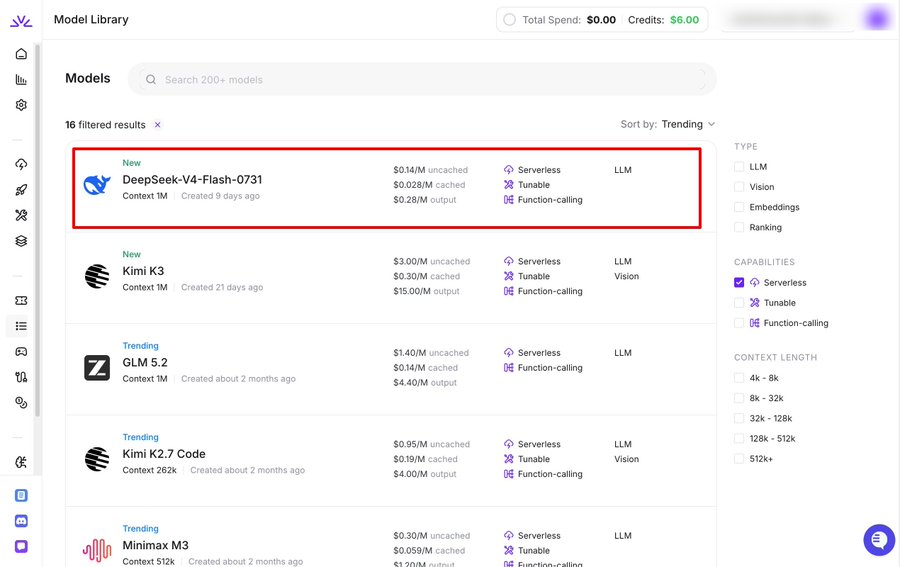
Fireworks AI Developer Free Credits: $6 Promotional Balance and DeepSeek V4 Flash Economics
Analysis of Fireworks AI promotional credits: $6 onboarding balance, 214M+ DeepSeek V4 Flash cached tokens, API rate limits, and Claude Code setup.
Lucky YaduvanshiTypeSafe AI Jev Architectural Deep Dive: System One Decision Models vs Generative LLMs
Why TypeSafe AI's Jev model captured 13% of Vercel AI Gateway teams in 24 hours. Deep dive into RLCD training, 70ms decision latency, and architecture.
Lucky YaduvanshiStep 5 Preview vs GLM-5.3 vs DeepSeek V4.1 Flash: The MoE Frontier Race
Step 5 Preview vs GLM-5.3 vs DeepSeek V4.1 Flash: architectural comparison of 600B MoE vs asymmetric 8B/16B routing, DeepSWE v1.1 benchmarks, and inference token economics.
Lucky Yaduvanshi