DeepSeek V4 Flash: Inference Latency, Context Window, and Cost Breakdown
DeepSeek V4 Flash features 284B parameters (13B active), a 1M token context window, and $0.14/$0.28 per million pricing. Here is the technical breakdown.

Synthesizing article benchmarks & model metrics...
With the deployment of DeepSeek V4 Flash, high-throughput language modeling has entered a new phase of economic efficiency. Rather than compressing a dense model into low-parameter approximations, DeepSeek structured V4 Flash as a 284-billion-parameter Mixture-of-Experts (MoE) network that activates only 13 billion parameters per token.
Priced at $0.14 per 1 million input tokens and $0.28 per 1 million output tokens, V4 Flash delivers native 1,000,000-token context processing at roughly one-tenth the cost of legacy small-model APIs like GPT-4o-mini and Claude 3.5 Haiku.
Below is an engineering overview of the architecture, memory compression techniques from arXiv:2606.19348, and practical latency measurements in production environments.
Technical Specifications: DeepSeek V4 Flash
| Specification | DeepSeek V4 Flash Metrics | Architectural Comparison |
|---|---|---|
| Model Type | Sparse Mixture of Experts (MoE) | Dynamic top-k expert routing |
| Total Parameters | 284 Billion | High capacity storage |
| Activated Parameters | 13 Billion per token | Equivalent execution cost to 13B dense |
| Pre-Training Corpus | >32 Trillion Tokens | Shared with V4 Pro series |
| Context Window | 1,000,000 Tokens (1M) | Native long-context attention |
| Maximum Output Length | 384,000 Tokens | Extended generation capability |
| Input Price (Cache Miss) | $0.14 / 1M tokens | 90% cheaper than traditional small APIs |
| Input Price (Cache Hit) | $0.0028 / 1M tokens | Sub-cent prompt caching |
| Output Price | $0.28 / 1M tokens | Predictable high-volume generation |
| Thinking Modes | Hybrid (Thinking & Non-Thinking) | Toggleable reasoning chain |
| Tool Calling & JSON | Native Function Calling | Supported in API and Ollama |
What Actually Changed? Architectural Economics
The central innovation in DeepSeek V4 Flash is the balance between total parametric knowledge (284B) and per-token inference FLOPs (13B):
- Active Compute vs Dense 30B: Because only 13B weights fire during any single forward pass, inference latency mirrors lightweight models, while the 284B parameter pool preserves broad domain facts and specialized syntax.
- Memory Footprint Compression: Using Compressed Sparse Attention (CSA), KV cache footprint across 1M tokens is compressed by 90% relative to standard Multi-Head Attention (MHA).
- Dual Mode Flexibility: In non-thinking mode, V4 Flash functions as an ultra-fast parser and autocomplete engine. In thinking mode, it generates internal chain-of-thought scratchpads before answering complex multi-step problems.
Where DeepSeek V4 Flash Performs Well
- High-Volume Context Processing: In retrieval-augmented generation (RAG) pipelines processing hundreds of PDFs or large logs, the $0.14/1M input pricing reduces API bills by thousands of dollars monthly.
- Fast Agentic Tool Dispatch: Because the model generates tokens at high throughput, it serves as an ideal sub-agent orchestrator for classifying requests, formatting JSON, and verifying lint rules.
- Low-Cost Local Deployment: For enterprise VPC deployments, quantizations of V4 Flash (such as Q4_K_M) fit comfortably across standard dual-GPU setups (2x RTX 4090 or 2x A6000), eliminating cloud vendor lock-in.
Known Trade-offs & Limitations
- Complex Formal Proofs: While thinking mode elevates math and logic accuracy, V4 Flash trails frontier models like DeepSeek V4 Pro and GPT-5.6 Sol on nuanced software architecture and competitive mathematics.
- Thinking Mode Latency Overhead: When reasoning is enabled, time-to-first-token (TTFT) increases as the model deliberates. Workloads requiring sub-200ms latency should explicitly set non-thinking mode.
Related Models & Discovery Resources
- Model Scorecard: Specs and ratings on DeepSeek V4 Flash 0731
- Compare Models: Simulate head-to-head performance in our LLM Comparison Engine
- Global Rankings: View all tracked models on the AI Model Leaderboard
- Catalog Directory: Browse all models in the All Models Directory
Benchmark and pricing data is aggregated from OpenRouter, Artificial Analysis, and models.dev, then scored with the published RankLLMs Index. These are the primary sources behind the numbers in this article.
- •DeepSeek API Official Pricing & Documentation(Primary Source →)
- •arXiv:2606.19348 Technical Report(Primary Source →)
- •Hugging Face Model Repository(Primary Source →)
Lucky Yaduvanshi(luckyyaduvanshi.in →)
Founder of RankLLMs • AI Researcher & Software Engineer focusing on LLM benchmarking, DevOps, and autonomous coding agents.
Recommended Reading
Continue exploring related technical benchmarks, model deep-dives, and autonomous coding agent guides.
DeepSeek V4 Flash 0731: Benchmarks, Features, and Inference Speed
DeepSeek V4 Flash 0731: post-training benchmarks across Terminal-Bench (82.7%) and DeepSWE (54.4%), 1M context efficiency, and $0.14/$0.28 token economics.
Lucky Yaduvanshi
Alibaba Model Studio Token Plan: Pricing Structure and Claude Code Integration
Comprehensive review of the Alibaba Cloud Model Studio Token Plan. We break down Singapore region access, Credits math, 7-day rolling limits, night discounts, Reddit community benchmarks, and Claude Code setup.
Lucky Yaduvanshi
Tencent Hy4 Preview: 770B MoE Architecture and 1M Context Window
Detailed analysis of Tencent Hy4 preview: 770B MoE architecture (49B active), 1M context window, Gated DSA attention, benchmark scores, and Apache 2.0 weights.
Lucky Yaduvanshi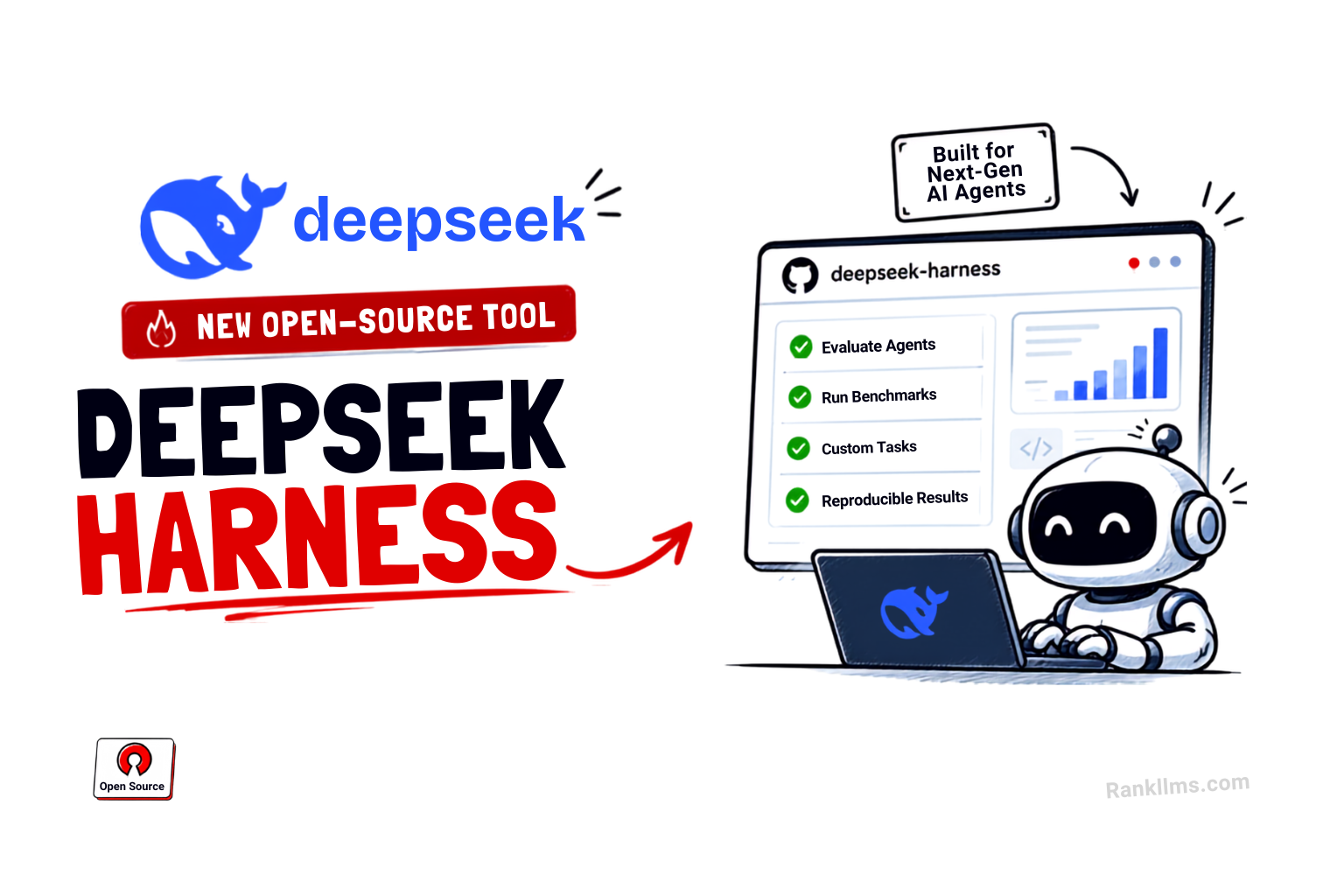
DeepSeek Harness: Architecture, Tool Execution, and Setup Guide
Comprehensive technical guide to DeepSeek Harness (dsh): Cordis micro-kernel architecture, append-only trajectory tracing, pluggable model adapters, and local deployment.
Lucky Yaduvanshi