Every Major AI Model Released in Early November 2026: Benchmarks, API Pricing, and Developer Migration Caveats
Compare every major AI model released in November 2026 - Claude Fable 5.2, Gemini 4 Hydrogen, Gemini 4 Carbon, GPT-6 Cyber, Muse Ember, and Kimi K3.1 Pro - with benchmarks and API pricing.
 Lucky YaduvanshiRankLLMs Editorial
Synthesizing article benchmarks & model metrics...
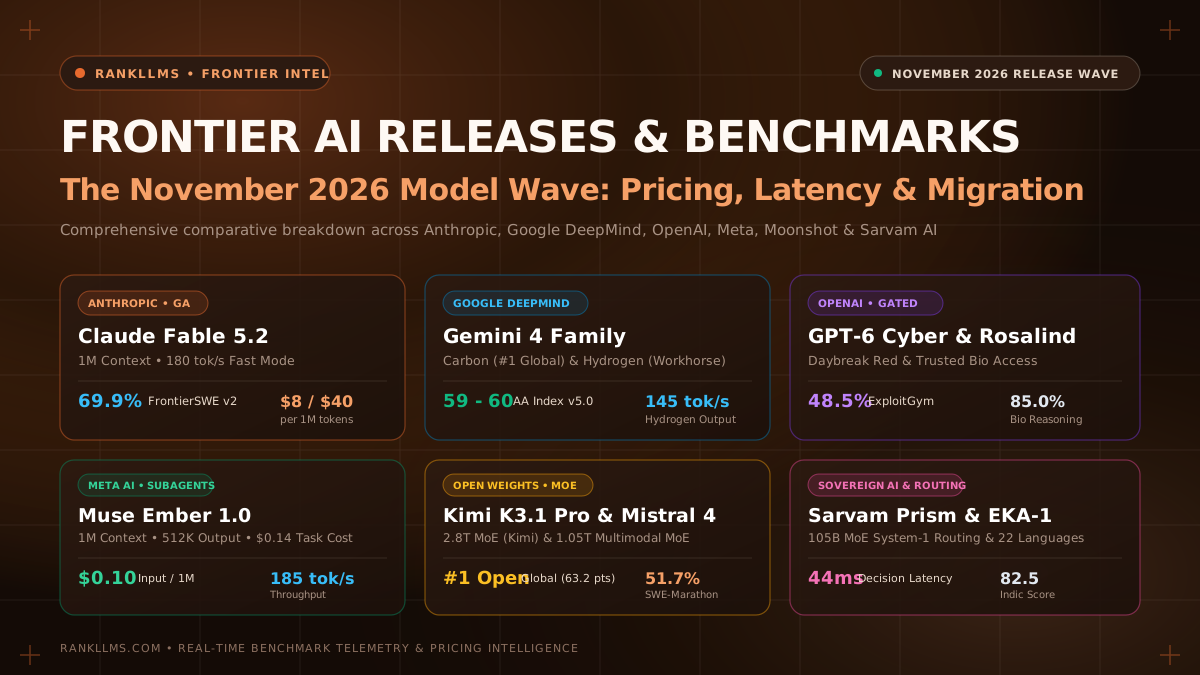
In the thirteen days between November 1 and November 13, 2026, major AI research laboratories released more than two dozen frontier, open-weight, and domain-specialized models. Headline releases include Anthropic’s Claude Fable 5.2 and Claude Mythos 5.2, Google’s Gemini 4 Hydrogen and Gemini 4 Carbon, OpenAI’s GPT-6 Cyber and GPT-Rosalind-6, Meta’s Muse Ember, open-weight Mixture-of-Experts (MoE) giants from Moonshot AI (Kimi K3.1 Pro) and Mistral AI (Mistral Large 4), and India’s indigenous Sarvam Prism.
For engineering teams, technical leads, and founders budgeting autonomous agent stacks on the RankLLMs Leaderboard, this release wave represents far more than incremental benchmark movement. Three architectural shifts now govern the November 2026 production ecosystem:
- Capability Gating Over Weight Separation: Labs are increasingly training a single frontier model and splitting deployment into commercial general availability (GA) and vetted research tiers with altered refusal boundaries for zero-day exploitation and wet-lab biological synthesis.
- A 40x Price Stratification Across Agent Loops: API pricing has split into two distinct tiers: ultra-low-cost worker models designed for high-frequency subagent loops ($0.10/1M input) and heavy orchestrators ($8.00/1M input).
- Production Migration Traps & Pricing Cliffs: Flagship releases ship with strict operational constraints, including multi-turn conversational history immutability and promotional pricing that doubles on December 1, 2026.
Master Comparison Table: November 1 - 13, 2026 Releases
The table below summarizes verified pricing, context specifications, and benchmark metrics for every major model released during this window. Scores are calibrated against the RankLLMs Scoring Methodology:
| Model | Provider | Release Date | Context / Max Output | Standard API Price (In / Out per 1M) | Verified Benchmark Highlights | Access & Production Caveats |
|---|---|---|---|---|---|---|
| Claude Fable 5.2 | Anthropic | Nov 9 | 1M / 128K | $8.00 / $40.00 (Fast: $16/$80; Cache: $0.20) | 49.1% FrontierCode (xhigh); 89.3% OSWorld 2.1; 69.9% FrontierSWE v2 | General Availability; 20% cheaper than Fable 5.1; rejects mid-thread history edits |
| Claude Mythos 5.2 | Anthropic | Nov 9 | 1M / 128K | $12.00 / $60.00 (Cache: $0.30) | 89.6% CVE Rediscovery; 76.3% CyScenarioBench; 85.1 Binder Design | Vetted access only for authorized cybersecurity & life sciences teams |
| Gemini 4 Hydrogen | Google DeepMind | Nov 12 | 1M / 64K | $1.50 / $7.50 (Cache: $0.075) | 54 AA Index v5.0 (xhigh); 100% PlotlyDataAnalytics; 145 tok/s speed | General Availability on Gemini API & Vertex AI; 4 configurable thinking levels |
| Gemini 4 Carbon | Google DeepMind | Nov 10 (GA) | 1M / 64K | $2.00 / $10.00 (Doubles to $4/$20 on Dec 1) | 60 AA Index v5.0 (high); 70.4% Vals Index v2.2; 77.4% ALE | Distributed via Fairwind Program; introductory rate expires November 30 |
| GPT-6 Cyber | OpenAI | Nov 5 | 1.05M / 128K | $20.00 / $100.00 (Cache: $2.00) | 48.5% ExploitGym; 61.0% CyScenarioBench; 40.3% Offensive Pentest | Daybreak Red gated access (GPT-6 Astra derivative for security teams) |
| GPT-Rosalind-6 | OpenAI | Oct 25 | 1M / 64K | $15.00 / $75.00 (Cache: $1.50) | 85.0% Bio capability score; 68.1% Terminal-Bench-Science 0.1 | Trusted Access only for certified biopharma and academic researchers |
| Muse Ember | Meta AI | Nov 10 | 1M / 512K | $0.10 / $0.50 (Cache: $0.01) | 36.0 AA Index v5.0; 185 tok/s speed; $0.14 avg task cost | GA on Meta Model API & Vertex AI; distilled worker model from Muse Wonder |
| Kimi K3.1 Pro | Moonshot AI | Nov 5 | 1.05M / 1M | $0.60 / $2.40 (Open Weights) | 51.7% SWE Marathon v1.1; 73.3% AutomationBench-AA; 67.0% TB 4.0 | #1 Open-Weights Worldwide (63.2 overall); 2.8T MoE (104B active) architecture |
| Mistral Large 4 | Mistral AI | Nov 5 | 1M / 128K | $0.40 / $1.20 (Open Weights) | 41.0% Terminal-Bench 4.0; 82.0% CyberGym; 51 AA Index v5.0 | 1.05T MoE (52B active) European sovereign model with Pixtral vision encoder |
| Qwen4-Max-Preview | Alibaba Qwen | Oct 30 | 1M / 32K | $1.20 / $4.00 (Cache: $0.15) | 78.4% SWE-bench Verified; 92.5% Math500; 1,890 Code Arena Elo | Preview tier on Alibaba Cloud Model Studio; 1M unified multimodal context |
| Sarvam Prism | Sarvam AI | Nov 5 | 128K / 8K | $0.15 / $0.45 (Open Weights) | 71.8 Decision Index; 82.5 Indic Decision Score; 44ms median latency | Open-weight 105B MoE System-1 model for real-time routing & policy scoring |
1. The Frontier Heavyweights & The Rise of “Capability Gating”
The defining strategic transition of late 2026 is capability gating: training a massive frontier foundation model and splitting its deployment between commercial general availability (GA) and restricted defense tiers with relaxed refusal guardrails for high-consequence domains.
flowchart TD
    BaseModel["Shared Frontier Base Weights (GPT-6 Astra / Fable 5.2 / Gemini 4)"]

    subgraph CommercialGA["Commercial General Availability (GA)"]
        GA1["Claude Fable 5.2 ($8 / $40)"]
        GA2["Gemini 4 Carbon / Hydrogen"]
        GA3["GPT-6 Astra ($10 / $50)"]
    end

    subgraph RestrictedResearch["Capability-Gated Research & Defense"]
        Gated1["Claude Mythos 5.2 (CVE Rediscovery & Bio Binder)"]
        Gated2["GPT-6 Cyber (Daybreak Red: ExploitGym)"]
        Gated3["GPT-Rosalind-6 (Trusted Access: Molecular Protocols)"]
    end

    BaseModel --> CommercialGA
    BaseModel --> RestrictedResearch
Anthropic: Claude Fable 5.2 and Mythos 5.2
Anthropic rolled out Claude Fable 5.2 (alongside a high-throughput Fast Mode tier delivering 180 tok/s) and Claude Mythos 5.2 on November 9, 2026. The release pairs top-tier software engineering and spatial design scores with a 20% price reduction relative to Claude Fable 5.1 ($8.00 input / $40.00 output per million tokens).
Detailed head-to-head testing reveals critical nuances across reasoning effort configurations:
- Effort-Level Cost Scaling: Fable 5.2 exposes five reasoning effort levels (
low,medium,high,xhigh, andmax), and benchmark performance curves scale asymmetrically:- FrontierCode 2.0 (evaluating whether code patches are accepted by open-source maintainers):
higheffort matches Claude Opus 5.5’s peak score (45.3% vs. 45.5%) at half the token expenditure, whilexhigheffort achieves a global record of 49.1%. - FrontierSWE v2: Scores 69.9%, leading GPT-6 Astra (65.5%), Claude Opus 5.5 (62.3%), and Gemini 4 Carbon (61.2%).
- Computer Use on OSWorld 2.1: Fable 5.2 captures the top position globally at 89.3% on the offline subset, improving over Opus 5.5 (87.2%) and Fable 5.1 (83.5%).
- AutomationBench: Reaches 51.4% at
maxeffort (compared to 39.7% atlow), proving that multi-app business workflows still require verified human verification guardrails.
- FrontierCode 2.0 (evaluating whether code patches are accepted by open-source maintainers):
- Claude Mythos 5.2’s Specialized Capabilities: Mythos 5.2 eliminates standard defensive refusals for accredited cybersecurity and life sciences teams. It scores 89.6% on CVE Rediscovery (up from Opus 5.5’s 81.3%), 76.3% on CyScenarioBench, and 85.1 on 24-hour de novo binder design - successfully modeling 28 out of 34 viral capsid structures for targeted gene therapy vectors.
You can inspect the complete head-to-head matchup in our Claude Fable 5.2 vs Claude Opus 5.5 Comparison.
OpenAI: GPT-6 Cyber and GPT-Rosalind-6
OpenAI executed a parallel gating deployment:
- GPT-6 Cyber: A specialized variant of GPT-6 Astra restricted to authorized enterprise security personnel under the Daybreak Red program. Evaluated on offensive web penetration testing, Linux kernel exploit audits, and binary analysis, GPT-6 Cyber scored 48.5% on ExploitGym and 61.0% on CyScenarioBench.
- GPT-Rosalind-6: Built on base Astra weights with safety boundaries re-calibrated for molecular biology, drug discovery, and genomic protocol troubleshooting. It records an 85.0% refusal-adjusted score across biological evaluation suites and matches Astra’s 68.1% on Terminal-Bench-Science 0.1.
Google DeepMind: Gemini 4 Carbon and Gemini 4 Hydrogen
Google completed a simultaneous two-tier launch across its frontier lineup:
- Gemini 4 Carbon: Positioned at #1 overall on RankLLMs (72.8 pts), Carbon leads the Artificial Analysis Intelligence Index v5.0 at 59 (GA) and hits 60 under
higheffort. It leads the RankLLMs Coding Leaderboard with 70.4% on Vals Index v2.2 and 77.4% on Agents’ Last Exam. - Gemini 4 Hydrogen: Priced at $1.50 input / $7.50 output ($0.075 cached read), Hydrogen replaces legacy Flash workflows with a 1M context window, four configurable thinking levels, and an output throughput of 145 tokens per second. On
lowthinking effort, Hydrogen completes standardized intelligence tasks in 1.3 minutes at $0.29 per task, scaling to a score of 54 underxhigheffort.
2. The Subagent & Efficiency Race ($0.10/1M Tokens)
As autonomous developer tools like Claude Code, Cursor, and open-source harnesses shift toward multi-agent coordination - where a primary planner delegates dozens of file reads, AST searches, and unit test executions to worker subagents - cost per loop has become the primary infrastructure bottleneck.
sequenceDiagram
    autonumber
    participant Orchestrator as Planner (Claude Fable 5.2 / GPT-6 Astra)
    participant Worker as Subagent (Meta Muse Ember / Gemini 4 Hydrogen)
    participant Tools as Local Workspace & Shell

    Orchestrator->>Worker: Dispatch subtask (1M context parsing & AST search)
    Note over Worker: Runs at $0.10/1M tokens & 185 tok/s
    Worker->>Tools: Run lint checks, ripgrep, and git diffs
    Tools-->>Worker: Return diagnostic logs
    Worker-->>Orchestrator: Return compact structured patch
    Note over Orchestrator: Synthesizes final PR at $8.00/1M
Meta AI: Muse Ember
Meta addressed subagent cost bottlenecks directly with Muse Ember, distilled from its flagship Muse Wonder Full architecture and distributed via the Meta Model API and Google Cloud Vertex AI:
- Inference Economics: At $0.10 per 1M input tokens, $0.01 per 1M cached input, and $0.50 per 1M output tokens (paired with a 1M context window and a massive 512K output capacity), Muse Ember reduces average task spend to just $0.14.
- Throughput & Latency: Sustains 185 tokens per second at steady state with sub-2.2-second p95 latency.
- Benchmark Competency: Records 36.0 on the Artificial Analysis Index v5.0, matching Claude Haiku 5.5 (36.2) while costing 67% less per task. It scores 83.7% on Vals Vibe Code Bench v1.1, making it the premier default choice for RAG retrieval, structured schema conversion, and subagent code refactoring.
For an overview of monthly plan subscriptions supporting these models, check our AI Coding Plans Guide.
3. Open-Weight Giants & Sovereign AI Breakthroughs
Proprietary vendors did not hold a monopoly on early November releases. Trillion-parameter Mixture-of-Experts (MoE) architectures and sovereign initiatives delivered major milestones across open-weights intelligence:
Massive Open-Weight MoEs: Kimi K3.1 Pro vs. Mistral Large 4
Moonshot AI and Mistral AI released trillion-parameter open-weight models representing distinct points on the speed-versus-reasoning Pareto frontier:
- Kimi K3.1 Pro: A 2.8-trillion-parameter MoE (104B active parameters per token) with a 1.05M context window. Securing #1 globally among open-weights models (63.2 pts) on RankLLMs, it achieves 51.7% on SWE Marathon v1.1, 73.3% on AutomationBench-AA, and 67.0% on Terminal-Bench 4.0 - virtually tying Claude Fable 5.2.
- Mistral Large 4 (“Le Chonk”): A 1.05-trillion-parameter multimodal MoE (52B active parameters per token) built on European sovereign infrastructure using 3,800 NVIDIA Grace Blackwell GPUs. Offered at $0.40 / $1.20 per 1M tokens, it leads open-weights defensive security with 82.0% on CyberGym and features native visual reasoning via a 1.6B Pixtral encoder.
- InclusionAI Ling 3.1 Flash: Captures 75.16% on FrontierSWE and 87.90% on CyberGym, offering high-speed agentic execution at 165 tokens per second under an MIT license.
- MiniMax M3.1 Flash: Delivers 185 tokens per second at $0.15 / $0.60 per 1M tokens, capturing 62.8% on AutomationBench v1.0.6 and 73.7% on DeepSWE v1.1.
- Qwen4-Max-Preview: Alibaba Cloud’s preview foundation model supporting 1M context, logging 78.4% on SWE-bench Verified and 1,890 Elo on Code Arena.
- Inkling-2-Small: Thinking Machines Lab’s 594-billion-parameter MoE (17B active parameters per token) with a 1M token context window, released under an Apache 2.0 license on Hugging Face (
thinkingmachines/Inkling-2-Small). Clocking 82.2% on SWE-bench Verified, 93.0% on GPQA Diamond, and 95.2% on MATH-500, it delivers top-tier frontier performance at an ultra-low API cost of $0.30 per 1M input tokens ($0.03 cached) and $1.00 per 1M output tokens via the Tinker API. Built-in DSpark speculation enables 75 tps throughput on vLLM.
For local deployment guides and quantization requirements, read our Open-Source LLM Guide.
India’s Sovereign AI Wave: Sarvam Prism and EKA-1
India’s domestic artificial intelligence ecosystem deployed three notable production models during this period:
- Sarvam Prism: Developed by Sarvam AI atop the Sarvam 105B MoE base, Prism is an open-weights “System-1” decision engine. It evaluates candidate actions and routes requests in a single forward pass with calibrated confidence scores (median latency of 44 milliseconds on an NVIDIA B200 GPU in FP8). Scoring 71.8 on the Decision Index and 82.5 on Indic Decision Benchmarks, it eliminates multi-token chain-of-thought overhead for enterprise triage and compliance filtering.
- EKA-1 (Soket Labs / IndiaAI Mission): An open-source 26.3-billion-parameter sparse hybrid model trained across ~7.5 trillion tokens in English and all 22 scheduled Indian languages, specifically optimized for banking, financial services, and cybersecurity.
- Dhīr 2B & 5B (ZenteiQ / IndiaAI Mission): Lightweight, offline-capable multilingual models engineered for air-gapped on-device deployment in defense and healthcare sectors.
4. Developer Reality Check: Breaking Changes & Pricing Cliffs
Before swapping API endpoints in production, software engineering teams must navigate three critical operational constraints:
1. Claude Fable 5.2 Strict History Mutability
- Rejection of Mid-Thread Edits: Unlike earlier Claude endpoints, Fable 5.2 enforces strict cryptographic sequence checks across multi-turn tool-use threads. Agent frameworks that dynamically rewrite previous assistant messages, prune intermediate tool results, or alter system prompts mid-session will receive HTTP
400validation errors. - Cross-Model Fallback Failures: If your gateway routes fallback requests from Fable 5.2 to Opus 5.5 mid-conversation, encrypted reasoning blocks emitted by Fable 5.2 cannot be decoded by Opus 5.5 and must be stripped before dispatching the retry.
- Zero Data Retention (ZDR): Standard API traffic defaults to a 30-day logging retention window unless your organization executes an enterprise ZDR amendment.
2. The December 1 Gemini 4 Carbon Price Doubling
Google DeepMind’s $2.00 / $10.00 per 1M token pricing for Gemini 4 Carbon is an introductory rate expiring on November 30, 2026. Effective December 1, 2026, prices double to $4.00 input / $20.00 output. Engineering teams designing long-context pipelines must calibrate unit economics against the December rate rather than promotional launch pricing.
3. Thinking-Token Budget Management
While Gemini 4 Hydrogen lists a modest headline price ($1.50 / $7.50 per 1M tokens), running it at xhigh thinking effort causes extensive reasoning token generation (averaging $3.16 per task on the Artificial Analysis index). In contrast, setting thinking effort to low or medium costs $0.29 to $1.27 per task. Always enforce explicit thinking_budget ceilings in production configurations.
5. Architectural Decision Matrix: How to Choose Your Stack
flowchart TD
    Start["Select Deployment Use Case"]

    Start --> HardCoding["Complex Repo Refactoring & CAD Design"]
    Start --> FastAgent["Daily Coding, Rapid Tool Loops & Subagents"]
    Start --> OpenSource["Self-Hosted & Private Sovereign Cloud"]
    Start --> Security["Authorized Red Teaming & Bio Research"]

    HardCoding --> Fable["Claude Fable 5.2 ($8/$40, high effort)"]
    HardCoding --> Carbon["Gemini 4 Carbon ($2/$10 promo)"]

    FastAgent --> Hydrogen["Gemini 4 Hydrogen (Worker agent, 145 tok/s)"]
    FastAgent --> Ember["Meta Muse Ember (RAG & subagents, $0.10/1M)"]

    OpenSource --> Kimi["Kimi K3.1 Pro (Frontier terminal coding, 63.2 pts)"]
    OpenSource --> Mistral["Mistral Large 4 (Multimodal MoE, $0.40/1M)"]
    OpenSource --> Sarvam["Sarvam Prism (44ms System-1 routing)"]

    Security --> Mythos["Claude Mythos 5.2 (89.6% CVE Rediscovery)"]
    Security --> Cyber["GPT-6 Cyber (ExploitGym 48.5%)"]
- Mission-Critical Repository Refactoring, CAD & Formal Logic: Deploy Claude Fable 5.2 at
highorxhigheffort. Reservemaxeffort for spatial CAD geometry and mission-critical synthesis where accuracy outweighs token cost. - High-Speed Daily Coding & Multi-Modal Debugging: Deploy Gemini 4 Hydrogen at
mediumthinking effort to secure sub-2-second latency and controlled task spend ($0.29 - $1.27/task). Review our Best LLM for Coding Guide for benchmark breakdowns. - High-Volume Subagent Worker Loops & Document RAG: Use Meta Muse Ember ($0.10 / $0.50 per 1M tokens) to handle tool calls, file indexing, and test validation beneath an orchestrator model.
- Self-Hosted On-Premise Clusters: Choose Kimi K3.1 Pro if you operate multi-node H100/B200 infrastructure and require top terminal accuracy (67.0% Terminal-Bench 4.0), or Mistral Large 4 for multimodal throughput and low serving overhead.
- Low-Latency Triage & Sovereign Applications: Deploy Sarvam Prism for deterministic 44ms decision routing and EKA-1 for 22-language Indian institutional compliance.
Frequently Asked Questions
What are the major AI models released in early November 2026?
Between November 1 and November 13, 2026, major releases included Anthropic’s Claude Fable 5.2 and Claude Mythos 5.2, Google’s Gemini 4 Hydrogen and Gemini 4 Carbon, OpenAI’s GPT-6 Cyber and GPT-Rosalind-6, Meta’s Muse Ember, Moonshot AI’s Kimi K3.1 Pro, Thinking Machines Lab’s Inkling-2-Small, Mistral Large 4, Alibaba’s Qwen4-Max-Preview, and Sarvam Prism.
What is the difference between Claude Fable 5.2 and Claude Mythos 5.2?
Both models share the same underlying frontier architecture, 1M context window, and core reasoning capabilities. However, Claude Fable 5.2 is generally available for software engineering, design, and enterprise reasoning, whereas Claude Mythos 5.2 is restricted to accredited cybersecurity and life sciences organizations, featuring specialized training for CVE remediation (89.6%) and macromolecular binder design (85.1) without standard defensive refusals.
How much do Gemini 4 Hydrogen and Gemini 4 Carbon cost?
Gemini 4 Hydrogen is priced at $1.50 per million input tokens and $7.50 per million output tokens ($0.075 for cached prompt reads). Gemini 4 Carbon is currently priced at an introductory rate of $2.00 input and $10.00 output through November 30, 2026, doubling to $4.00 input and $20.00 output on December 1, 2026.
Which November 2026 AI model is cheapest for autonomous agent loops?
Meta Muse Ember is the most cost-effective release in the November 2026 wave at $0.10 per million input tokens ($0.01 cached) and $0.50 per million output tokens. It delivers an average task cost of $0.14 on the Artificial Analysis index while sustaining 185 tokens per second.
What open-weight AI models launched in November 2026?
Prominent open-weights releases include Moonshot AI’s Kimi K3.1 Pro (2.8T MoE, #1 open-weights model globally), Thinking Machines Lab’s Inkling-2-Small (594B MoE with 17B active parameters, 82.2% SWE-bench), Mistral Large 4 (1.05T MoE), Sarvam Prism (105B MoE System-1 decision model), and IndiaAI Mission’s EKA-1 (26.3B sparse hybrid model across 22 scheduled Indian languages).
Primary Research & Verified Documentation
- Anthropic Research: Introducing Claude Fable 5.2 and Claude Mythos 5.2
- Google DeepMind: Introducing Gemini 4 Hydrogen & Gemini 4 Carbon Availability
- Thinking Machines Lab: Inkling-2-Small Announcement & Model Card
- Hugging Face: thinkingmachines/Inkling-2-Small Repository
- OpenAI Deployment Safety: Introducing GPT-6 Cyber & GPT-Rosalind-6 Research
- Meta AI Research: Introducing Our Smallest, Most Efficient Model: Muse Ember
- Sarvam AI Research: Sarvam Prism Research & Technical Specifications
- Moonshot AI: Kimi K3.1 Pro Open-Weights Repository
- Artificial Analysis: Intelligence Index v5.0 Comparative Evaluations
Frequently Asked Questions
What are the major AI models released in early November 2026?
Between November 1 and November 13, 2026, major releases included Anthropic's Claude Fable 5.2 and Mythos 5.2, Google's Gemini 4 Hydrogen and Gemini 4 Carbon, OpenAI's GPT-6 Cyber and GPT-Rosalind-6, Meta's Muse Ember 1.0, Moonshot AI's Kimi K3.1 Pro, Mistral Large 4, Alibaba's Qwen4-Max-Preview, and Sarvam Prism.
What is the difference between Claude Fable 5.2 and Claude Mythos 5.2?
Both models share the same underlying frontier architecture, 1M context window, and $8/$40 per million token pricing, but differ in capability gating. Claude Fable 5.2 is generally available for software engineering and reasoning, whereas Claude Mythos 5.2 is restricted to vetted cybersecurity and life sciences organizations with fewer defensive refusals.
How much do Gemini 4 Hydrogen and Gemini 4 Carbon cost per million tokens?
Gemini 4 Hydrogen is priced at $1.50 per million input tokens and $7.50 per million output tokens ($0.075 for cached input). Gemini 4 Carbon is priced at an introductory rate of $2.00 input and $10.00 output through November 30, 2026, doubling to $4.00 input and $20.00 output on December 1, 2026.
Which November 2026 AI model is cheapest for high-volume subagent loops?
Meta's Muse Ember 1.0 is the most cost-efficient release in the November 2026 wave at $0.10 per million input tokens ($0.004 cached) and $0.50 per million output tokens, achieving an average task cost of $0.14 on the Artificial Analysis index while maintaining a 1M context window.
What open-weight AI models launched in November 2026?
Notable open-weight releases in early November 2026 include Moonshot AI's Kimi K3.1 Pro (2.8T MoE), Mistral Large 4 (1.05T MoE), desktop automation suites NorKa and NorthCUA, and Indian sovereign models EKA-1 (26.3B across 22 scheduled Indian languages), Dhīr 2B/5B, and Sarvam Prism.
Source links for data and claims discussed in this article are listed below. Refer to each source for its current figures and methodology.
- •Anthropic: Introducing Claude Fable 5.2 and Claude Mythos 5.2(source)
- •Google DeepMind: Introducing Gemini 4 Hydrogen(source)
- •Google DeepMind: Gemini 4 Carbon Now Available(source)
- •OpenAI: Introducing GPT-6 Cyber(source)
- •OpenAI: GPT-Rosalind-6 Deployment Safety(source)
- •Meta AI: Muse Ember Technical Report(source)
- •Thinking Machines Lab: Inkling-2-Small Announcement(source)
- •Thinking Machines Lab: Model Card - Inkling 2 Small(source)
- •Hugging Face: thinkingmachines/Inkling-2-Small(source)
- •Google DeepMind: Introducing Gemini 4 Carbon(source)
- •OpenAI: Introducing GPT-6 Cyber(source)
- •OpenAI Deployment Safety: GPT-Rosalind-6(source)
- •Meta AI Research: Introducing Muse Ember(source)
- •Sarvam AI: Sarvam Prism Research Blog(source)
- •Moonshot AI: Kimi K3.1 Pro on Hugging Face(source)
- •Alibaba Cloud: Model Studio Newly Released Models(source)
- •Artificial Analysis Intelligence Index v5.0(source)
Lucky Yaduvanshi(luckyyaduvanshi.in →)
Founder of RankLLMs • AI Researcher & Software Engineer focusing on LLM benchmarking, DevOps, and autonomous coding agents.
Recommended Reading
Related by topic and recency.
Claude Code vs Gemini CLI vs GitHub Copilot CLI (2026 Tested)
Terminal AI coding agents compared: Claude Code CLI, Google Gemini CLI, and GitHub Copilot CLI tested on multi-file edits, context limits, and pricing.
Llama 3.1 8B vs Llama 3.2 3B: Local VRAM, Speed & Benchmarks
Llama 3.1 8B vs Llama 3.2 3B compared for local deployment: published Meta benchmarks, quantization VRAM requirements, edge speed, and coding accuracy.
GLM-5.3-FlashX: 200 Tokens/sec Throughput vs 2.5x Price Analysis
Review GLM-5.3-FlashX provider speed claims, current API rates, task-cost math, and how to measure whether faster serving helps your coding workflow.